Blab Tech
Indias RBI Highlights Challenges Ahead as Tokenized Bonds Enter Market
At the Global Fintech Fest 2026, RBI executive director P. Vasudevan addressed an eager audience in a fireside chat, mapping the obstacles India faces as it pushes the tokenization of financial assets forward. He warned that legal uncertainty, data privacy, liquidity, interoperability, and the danger of excessive concentration could slow progress.
Tokenization—digitally representing ownership and transaction records on a blockchain—has already been piloted by the RBI through its Unified Markets Interface (UMI). According to Vasudevan, the UMI has processed 248 certificate‑of‑deposit transactions worth ₹17,000 crore, with roughly two‑thirds occurring in the secondary market. He added that tokenization can span an asset’s entire lifecycle—from issuance and trading to settlement, interest payments and servicing.
The RBI is also eyeing wider applications, such as tokenizing bank deposits. Vasudevan noted that markets in Europe, the UK, the US and Asia are experimenting with similar models, while cautioning that regulatory and financial‑stability implications must be weighed. Tokenization of gold is also being explored overseas.
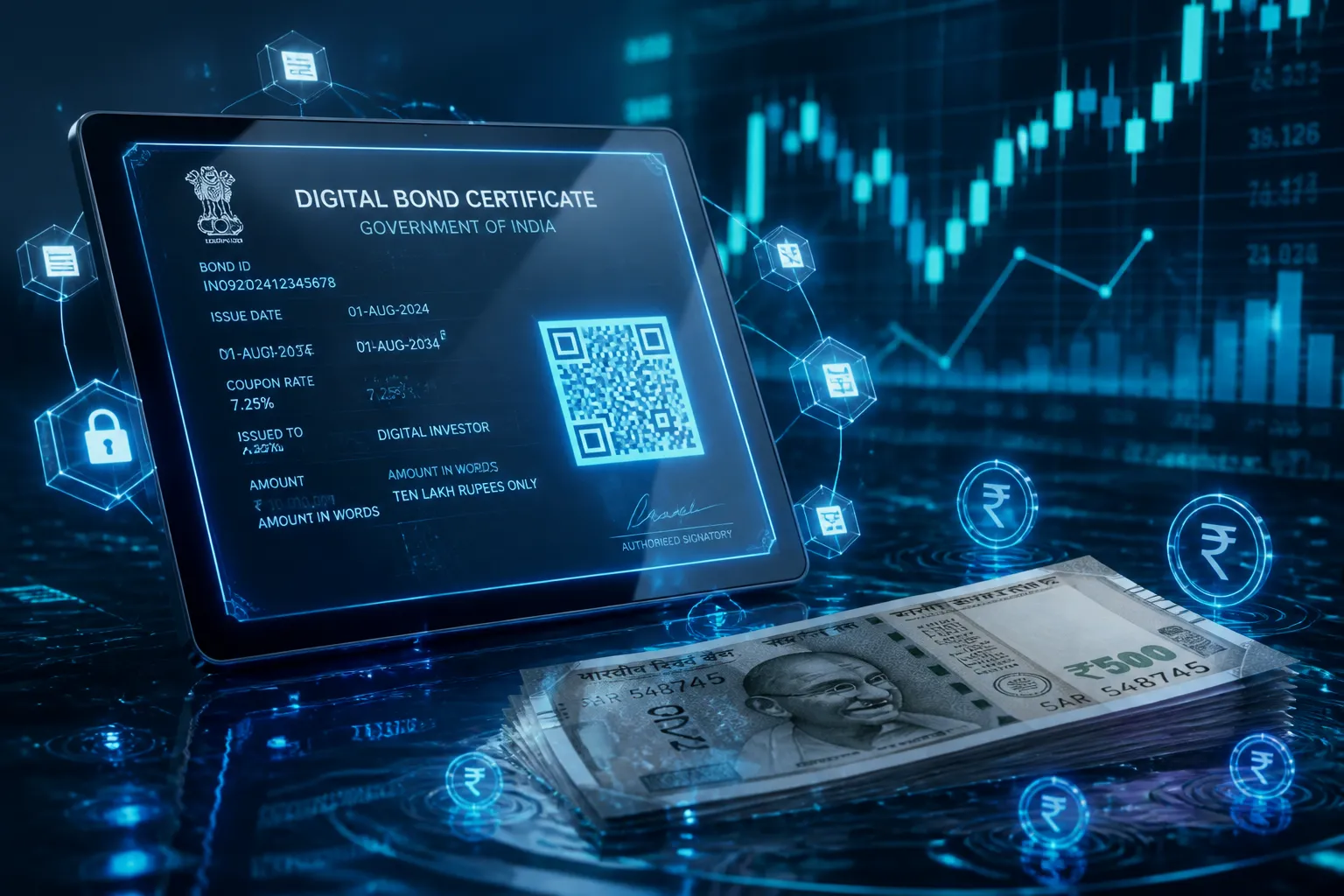
The RBI’s pilot of tokenized corporate bonds is transitioning from experimentation to real fundraising. On Monday, state‑run power financier REC raised ₹500 crore through India’s first pilot issue of tokenized corporate bonds maturing on 31 May 2028 at a coupon of 7.30 %. The issue had a base size of ₹100 crore and a green‑shoe option of ₹400 crore. Larsen & Toubro followed on Wednesday, raising ₹500 crore via a similar mechanism, with bonds maturing in three years at a coupon of 7.40 %. Both issuances were conducted under the Securities and Exchange Board of India (SEBI) regulatory sandbox framework.
Unlike a traditional bond, where ownership and settlement flow through established securities‑market infrastructure, tokenized bonds enable digital recording and potentially near‑instant settlement. The underlying instrument remains a bond, with the issuer still liable for coupon payments and repayment of principal at maturity.
The REC issue is part of a larger initiative by the RBI and SEBI to test tokenized corporate bonds. It uses the RBI’s wholesale central bank digital currency (CBDC) for payment and a blockchain‑based securities wallet, dubbed “DEMAT 2.0,” for holding securities. Only investors who hold active security and CBDC wallets are permitted to place bids for the issue.
Tokenization could cut settlement risk, boost transparency, and automate portions of the bond lifecycle. It also allows fractional ownership, potentially lowering investment thresholds and widening participation in corporate bonds. However, market participants have highlighted the need for supporting infrastructure and a sufficiently liquid secondary market for the technology to scale.
Vasudevan stressed that existing market intermediaries would need to be reimagined rather than eliminated. Depositories, custodians, clearing corporations and exchanges could transform into token service providers or offer tokenization as a service.
He cautioned that initial costs are steep and that legal clarity, data privacy, data movement, and consent management present significant hurdles. “If there are two or three platforms doing similar things, how do we actually make them interoperable?” Vasudevan asked. He added that interoperability has been one of the success stories of India’s payments ecosystem and should not be lost in the shift toward tokenized assets.
The RBI is eager to broaden the range of asset classes that can be tokenized. “Tokenization is for the future,” Vasudevan said, emphasizing that its expansion requires both optimism and caution.
The REC and L&T issuances mark the first steps in a wider shift toward tokenized debt markets in India. The pilot has attracted roughly 20 investors, including banks, mutual funds and corporates. The technology’s success hinges on developing robust secondary markets, clear regulatory guidance, and the ability of market intermediaries to adapt to a token‑centric infrastructure.
As India continues to test and roll out tokenization, stakeholders must keep a close eye on how the RBI’s regulatory sandbox evolves, how the CBDC settlement system performs, and whether the market can deliver the promised liquidity and transparency.
Today, tokenized bonds remain in the early pilot phase, with the next round of issuances slated for the coming months. The RBI and SEBI are expected to issue further guidance on interoperability standards, legal frameworks and risk‑management practices soon.
Tokenization—digitally representing ownership and transaction records on a blockchain—has already been piloted by the RBI through its Unified Markets Interface (UMI). According to Vasudevan, the UMI has processed 248 certificate‑of‑deposit transactions worth ₹17,000 crore, with roughly two‑thirds occurring in the secondary market. He added that tokenization can span an asset’s entire lifecycle—from issuance and trading to settlement, interest payments and servicing.
The RBI is also eyeing wider applications, such as tokenizing bank deposits. Vasudevan noted that markets in Europe, the UK, the US and Asia are experimenting with similar models, while cautioning that regulatory and financial‑stability implications must be weighed. Tokenization of gold is also being explored overseas.
The RBI’s pilot of tokenized corporate bonds is transitioning from experimentation to real fundraising. On Monday, state‑run power financier REC raised ₹500 crore through India’s first pilot issue of tokenized corporate bonds maturing on 31 May 2028 at a coupon of 7.30 %. The issue had a base size of ₹100 crore and a green‑shoe option of ₹400 crore. Larsen & Toubro followed on Wednesday, raising ₹500 crore via a similar mechanism, with bonds maturing in three years at a coupon of 7.40 %. Both issuances were conducted under the Securities and Exchange Board of India (SEBI) regulatory sandbox framework.
Unlike a traditional bond, where ownership and settlement flow through established securities‑market infrastructure, tokenized bonds enable digital recording and potentially near‑instant settlement. The underlying instrument remains a bond, with the issuer still liable for coupon payments and repayment of principal at maturity.
The REC issue is part of a larger initiative by the RBI and SEBI to test tokenized corporate bonds. It uses the RBI’s wholesale central bank digital currency (CBDC) for payment and a blockchain‑based securities wallet, dubbed “DEMAT 2.0,” for holding securities. Only investors who hold active security and CBDC wallets are permitted to place bids for the issue.
Tokenization could cut settlement risk, boost transparency, and automate portions of the bond lifecycle. It also allows fractional ownership, potentially lowering investment thresholds and widening participation in corporate bonds. However, market participants have highlighted the need for supporting infrastructure and a sufficiently liquid secondary market for the technology to scale.
Vasudevan stressed that existing market intermediaries would need to be reimagined rather than eliminated. Depositories, custodians, clearing corporations and exchanges could transform into token service providers or offer tokenization as a service.
He cautioned that initial costs are steep and that legal clarity, data privacy, data movement, and consent management present significant hurdles. “If there are two or three platforms doing similar things, how do we actually make them interoperable?” Vasudevan asked. He added that interoperability has been one of the success stories of India’s payments ecosystem and should not be lost in the shift toward tokenized assets.
The RBI is eager to broaden the range of asset classes that can be tokenized. “Tokenization is for the future,” Vasudevan said, emphasizing that its expansion requires both optimism and caution.
The REC and L&T issuances mark the first steps in a wider shift toward tokenized debt markets in India. The pilot has attracted roughly 20 investors, including banks, mutual funds and corporates. The technology’s success hinges on developing robust secondary markets, clear regulatory guidance, and the ability of market intermediaries to adapt to a token‑centric infrastructure.
As India continues to test and roll out tokenization, stakeholders must keep a close eye on how the RBI’s regulatory sandbox evolves, how the CBDC settlement system performs, and whether the market can deliver the promised liquidity and transparency.
Today, tokenized bonds remain in the early pilot phase, with the next round of issuances slated for the coming months. The RBI and SEBI are expected to issue further guidance on interoperability standards, legal frameworks and risk‑management practices soon.