Blab Tech
General Atomics Secures $20 Million California Tax Credit to Build Fusion Blanket Test Facility
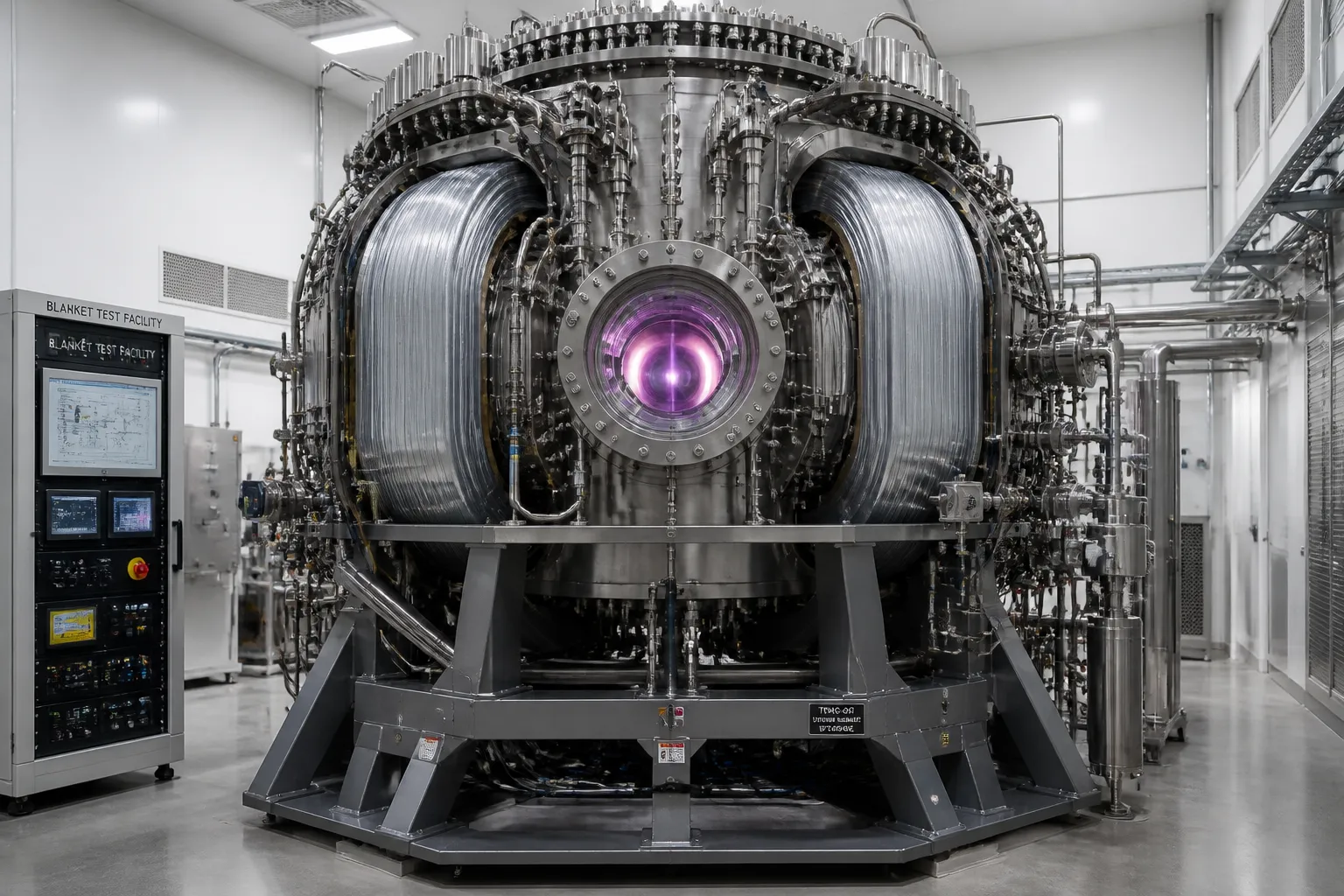
In a landmark move that could bring fusion closer to reality, General Atomics (GA) announced on June 22 that it has been awarded a $20 million California Competes Tax Credit. The grant will fund the design and construction of a new Fusion Blanket Component Test Facility (BCTF) in San Diego, a site that will put lithium‑based breeding blankets under the harsh conditions of a real tokamak.
The BCTF’s core mission is to test whether a full‑scale blanket can absorb neutron energy, generate heat, and produce tritium—critical functions for a commercial fusion plant. In such a plant the blanket must act as both heat exchanger and fuel source; without it the reactor would need an external tritium supply, a major limitation on its practicality.
Fusion reactors rely on deuterium–tritium (D‑T) fuel. Deuterium can be extracted from seawater, but tritium is a short‑lived, radioactive isotope with a 12.3‑year half‑life, leaving only a few kilograms on Earth. The only viable way to sustain a fusion chain is to manufacture tritium inside the reactor itself. A lithium alloy blanket captures the high‑energy neutrons produced by D‑T fusion. When a neutron strikes a lithium‑6 nucleus, the reaction ⁶Li + n → ⁴He + ³H + 4.8 MeV releases tritium and heat.
Engineering a blanket that can withstand the intense magnetic fields, extreme temperatures, and neutron bombardment of a tokamak is a major technical hurdle. The blanket must retain structural integrity, manage heat loads, and allow efficient tritium extraction without contaminating the reactor environment. Until now, no full‑scale blanket has been tested in a reactor‑like setting, leaving design assumptions largely unverified.
GA’s BCTF will be built in partnership with the U.S. Department of Energy (DOE), Idaho National Laboratory, the University of California, San Diego, and a range of industrial and academic collaborators. DOE brings national‑lab expertise in neutron transport and materials testing, while Idaho National Laboratory contributes experience with fusion‑related experiments. UC San Diego provides academic research capabilities, and industry partners contribute manufacturing and testing equipment.
The facility’s primary goal is to validate blanket concepts that can be incorporated into future commercial reactors. By demonstrating that a blanket can produce sufficient tritium and heat under realistic neutron fluxes, the BCTF will help ensure that the next generation of fusion power plants can be self‑sufficient in fuel and energy output. If successful, the data will inform the design of the planned DEMO plant, the first experimental fusion power plant expected to generate electricity.
The BCTF fits into a broader fusion research timeline. ITER, the international tokamak under construction in France, aims to demonstrate plasma physics and tritium breeding but will not produce net electricity. The DOE’s fusion program and other national laboratories are working on smaller, more advanced prototypes that could reach commercial viability in the 2040s. The BCTF’s results will be critical for bridging the gap between experimental devices and commercial reactors.
At present the BCTF is in the design phase. GA has outlined preliminary plans for a 1‑meter‑scale blanket module that will be exposed to neutron fluxes representative of a full‑size tokamak. The next steps include finalizing engineering specifications, securing construction permits, and beginning fabrication. Completion of the facility is expected within the next two to three years, after which testing will commence.
The California tax credit underscores the state’s commitment to advanced energy research and positions San Diego as a hub for fusion technology development. While the BCTF will not solve all challenges of commercial fusion, it represents a significant step toward validating a key component that could enable reactors to produce their own fuel and electricity.
The BCTF’s core mission is to test whether a full‑scale blanket can absorb neutron energy, generate heat, and produce tritium—critical functions for a commercial fusion plant. In such a plant the blanket must act as both heat exchanger and fuel source; without it the reactor would need an external tritium supply, a major limitation on its practicality.
Fusion reactors rely on deuterium–tritium (D‑T) fuel. Deuterium can be extracted from seawater, but tritium is a short‑lived, radioactive isotope with a 12.3‑year half‑life, leaving only a few kilograms on Earth. The only viable way to sustain a fusion chain is to manufacture tritium inside the reactor itself. A lithium alloy blanket captures the high‑energy neutrons produced by D‑T fusion. When a neutron strikes a lithium‑6 nucleus, the reaction ⁶Li + n → ⁴He + ³H + 4.8 MeV releases tritium and heat.
Engineering a blanket that can withstand the intense magnetic fields, extreme temperatures, and neutron bombardment of a tokamak is a major technical hurdle. The blanket must retain structural integrity, manage heat loads, and allow efficient tritium extraction without contaminating the reactor environment. Until now, no full‑scale blanket has been tested in a reactor‑like setting, leaving design assumptions largely unverified.
GA’s BCTF will be built in partnership with the U.S. Department of Energy (DOE), Idaho National Laboratory, the University of California, San Diego, and a range of industrial and academic collaborators. DOE brings national‑lab expertise in neutron transport and materials testing, while Idaho National Laboratory contributes experience with fusion‑related experiments. UC San Diego provides academic research capabilities, and industry partners contribute manufacturing and testing equipment.
The facility’s primary goal is to validate blanket concepts that can be incorporated into future commercial reactors. By demonstrating that a blanket can produce sufficient tritium and heat under realistic neutron fluxes, the BCTF will help ensure that the next generation of fusion power plants can be self‑sufficient in fuel and energy output. If successful, the data will inform the design of the planned DEMO plant, the first experimental fusion power plant expected to generate electricity.
The BCTF fits into a broader fusion research timeline. ITER, the international tokamak under construction in France, aims to demonstrate plasma physics and tritium breeding but will not produce net electricity. The DOE’s fusion program and other national laboratories are working on smaller, more advanced prototypes that could reach commercial viability in the 2040s. The BCTF’s results will be critical for bridging the gap between experimental devices and commercial reactors.
At present the BCTF is in the design phase. GA has outlined preliminary plans for a 1‑meter‑scale blanket module that will be exposed to neutron fluxes representative of a full‑size tokamak. The next steps include finalizing engineering specifications, securing construction permits, and beginning fabrication. Completion of the facility is expected within the next two to three years, after which testing will commence.
The California tax credit underscores the state’s commitment to advanced energy research and positions San Diego as a hub for fusion technology development. While the BCTF will not solve all challenges of commercial fusion, it represents a significant step toward validating a key component that could enable reactors to produce their own fuel and electricity.








