Blab Tech
LandSpace Achieves First Successful Landing of Stainless-Steel First-Stage Booster on Chinese Soil
In a milestone for Chinese spaceflight, LandSpace Technology Corporation rolled back its ZhuQue‑3 (ZQ‑3) rocket’s first‑stage booster to a landing pad on August 18 2026, becoming the first company worldwide to recover an orbital‑class booster on land using stainless‑steel legs.
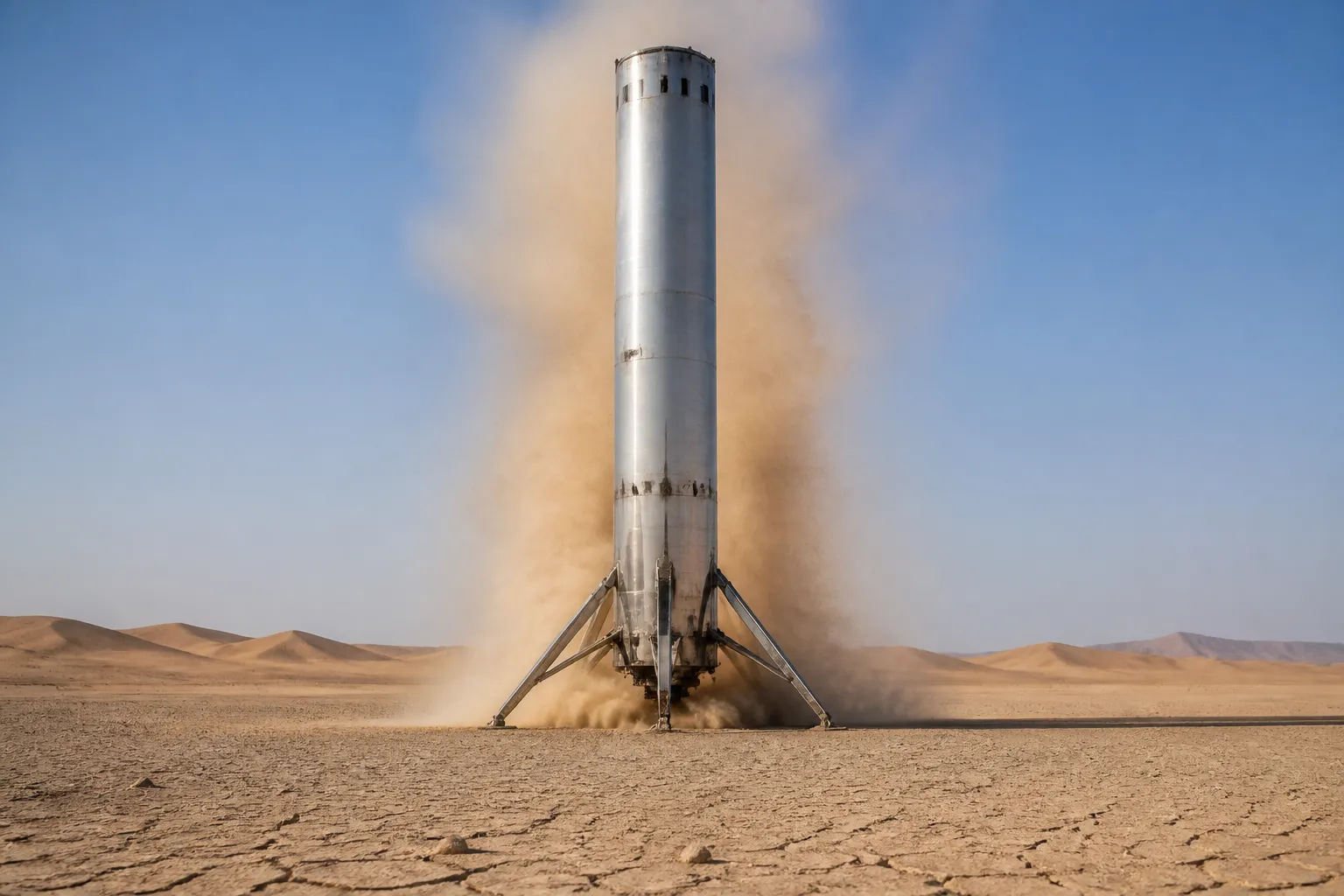
The ZQ‑3 lifted off from the Dongfeng Commercial Space Innovation Pilot Zone at 7:35 a.m. CST (23:35 UTC). After a two‑minute coast, the booster detached and began a choreographed descent toward Minqin County in Gansu Province. Eight minutes after liftoff, the vehicle touched down on its designated pad. A short burst of flame appeared in the aft section when the booster landed, but footage posted on social media shows the landing legs intact and no damage.
LandSpace described the flight as “China’s first‑ever successful recovery attempt of the first stage of an orbital‑class launch vehicle using landing legs, and China’s first successful booster recovery on land.” The company added that the mission is a “pivotal flight test” as the ZQ‑3 moves from a demonstration phase to an engineering‑application phase of reusability.
The 76.6‑meter (251‑foot) two‑stage ZQ‑3 is built from stainless steel and features chines that reduce aerodynamic drag. It carries liquid methane and liquid oxygen (methalox) as propellant. The first stage houses nine Tianzhi‑series engines, while the second stage uses a vacuum‑variant engine. Design innovations include a reduced‑engine landing burn, an onboard flight‑termination system with a predicted‑impact‑point safety function, and a redesigned thermal‑protection system that can withstand re‑entry heat.
The ZQ‑3’s first flight on December 3 2025 delivered a payload to orbit but failed to recover the booster; Xinhua reported an “abnormal combustion” during the recovery attempt. The second flight incorporated the optimizations described above and achieved a successful landing.
LandSpace also confirmed that the mission validated its hold‑down and release mechanism for payload deployment, a feature the company says will support future large‑scale constellation launches and rapid batch deployment.
The ZQ‑3 is part of LandSpace’s broader portfolio, which includes the single‑use ZQ‑2E rocket that has flown six times since November 2024.
China’s reusable‑rocket landscape expanded this year. The China Aerospace Science and Technology Corporation (CASC) recovered the first stage of its Long March 10B on July 10, using a net‑based catching system on a floating platform. Unlike the ZQ‑3’s landing legs, the Long March 10B was caught by a series of tensioned wires.
In the United States, SpaceX continues to lead with 614 reflown Falcon 9 boosters, and Blue Origin recovered its New Glenn booster on its second flight in November 2025. Other U.S. companies—Firefly Aerospace, Relativity Space, Rocket Lab, and Stoke Space—are preparing inaugural flights of reusable medium‑lift rockets.
LandSpace’s achievement places it among a small group of launch providers that have successfully propulsively landed a booster for potential reuse. The company’s next steps will likely involve further testing of the ZQ‑3’s reusability, integration of the hold‑down mechanism for larger payloads, and potential commercial launch contracts.
At present, the ZQ‑3’s second flight demonstrates a viable path to reusable launch services in China, but the company has not yet announced a schedule for subsequent flights or a plan to recover the booster for reuse. The broader industry will watch to see whether LandSpace can translate this landing success into operational cost savings and increased launch cadence.
The ZQ‑3 lifted off from the Dongfeng Commercial Space Innovation Pilot Zone at 7:35 a.m. CST (23:35 UTC). After a two‑minute coast, the booster detached and began a choreographed descent toward Minqin County in Gansu Province. Eight minutes after liftoff, the vehicle touched down on its designated pad. A short burst of flame appeared in the aft section when the booster landed, but footage posted on social media shows the landing legs intact and no damage.
LandSpace described the flight as “China’s first‑ever successful recovery attempt of the first stage of an orbital‑class launch vehicle using landing legs, and China’s first successful booster recovery on land.” The company added that the mission is a “pivotal flight test” as the ZQ‑3 moves from a demonstration phase to an engineering‑application phase of reusability.
The 76.6‑meter (251‑foot) two‑stage ZQ‑3 is built from stainless steel and features chines that reduce aerodynamic drag. It carries liquid methane and liquid oxygen (methalox) as propellant. The first stage houses nine Tianzhi‑series engines, while the second stage uses a vacuum‑variant engine. Design innovations include a reduced‑engine landing burn, an onboard flight‑termination system with a predicted‑impact‑point safety function, and a redesigned thermal‑protection system that can withstand re‑entry heat.
The ZQ‑3’s first flight on December 3 2025 delivered a payload to orbit but failed to recover the booster; Xinhua reported an “abnormal combustion” during the recovery attempt. The second flight incorporated the optimizations described above and achieved a successful landing.
LandSpace also confirmed that the mission validated its hold‑down and release mechanism for payload deployment, a feature the company says will support future large‑scale constellation launches and rapid batch deployment.
The ZQ‑3 is part of LandSpace’s broader portfolio, which includes the single‑use ZQ‑2E rocket that has flown six times since November 2024.
China’s reusable‑rocket landscape expanded this year. The China Aerospace Science and Technology Corporation (CASC) recovered the first stage of its Long March 10B on July 10, using a net‑based catching system on a floating platform. Unlike the ZQ‑3’s landing legs, the Long March 10B was caught by a series of tensioned wires.
In the United States, SpaceX continues to lead with 614 reflown Falcon 9 boosters, and Blue Origin recovered its New Glenn booster on its second flight in November 2025. Other U.S. companies—Firefly Aerospace, Relativity Space, Rocket Lab, and Stoke Space—are preparing inaugural flights of reusable medium‑lift rockets.
LandSpace’s achievement places it among a small group of launch providers that have successfully propulsively landed a booster for potential reuse. The company’s next steps will likely involve further testing of the ZQ‑3’s reusability, integration of the hold‑down mechanism for larger payloads, and potential commercial launch contracts.
At present, the ZQ‑3’s second flight demonstrates a viable path to reusable launch services in China, but the company has not yet announced a schedule for subsequent flights or a plan to recover the booster for reuse. The broader industry will watch to see whether LandSpace can translate this landing success into operational cost savings and increased launch cadence.








