Blab Tech
Former Axon President Luke Larson Builds Seattle Matcha Empire with Automated Dispensers
Luke Larson, who led the law‑enforcement technology company Axon from 2017 until 2022, has turned his experience in high‑stakes operations into a new venture that blends premium green tea with robotics. The Seattle‑based startup Vale, founded in 2024, is positioning itself as a matcha‑centric alternative to the city’s coffee culture.
Larson’s career began in the U.S. Marine Corps, where he completed two tours in Iraq and earned a Bronze Star with V for valor. After leaving the military, he joined Axon, a maker of Tasers and body‑worn cameras. In 2017 he was promoted to president, and during his tenure the company’s sales grew from roughly $100 million to about $1 billion. Larson also oversaw the construction of a Seattle campus that became known for its distinctive recruitment tactics and mission‑driven culture.
In 2022 Larson stepped down from Axon after a sudden health scare. He took a six‑month medical leave that extended into a two‑year sabbatical in Switzerland with his family. While recuperating, Larson was introduced to matcha by Chef Jeffrey Hayden, a Culinary Institute of America graduate who had worked in Michelin‑starred kitchens. Hayden explained that ceremonial‑grade matcha, when prepared correctly and served cold, delivers a smooth, focused experience without the jitters of coffee.
According to a GeekWire article, the conversation sparked a vision that led Larson to return to Seattle and launch Vale. The company’s headquarters are in Pioneer Square, and its first café opened in the South Lake Union neighborhood in May 2025. A second permanent location on First Hill is under development. In addition to brick‑and‑mortar sites, Vale operates a fleet of mobile matcha bars. The startup has 23 mobile units in operation this summer, with plans to expand to 100 by year‑end and 1,000 nationwide next year.
Vale’s product line is built around ceremonial‑grade matcha sourced from the Shizuoka region of Japan. Chef Hayden, who serves as Head of Craft, has worked to remove the traditional pretensions of Japanese tea ceremonies and create a menu that includes classic iced matcha, plant‑based lattes, and seasonal drinks such as a strawberry matcha latte that costs $7. The latte combines green matcha, oat milk, and a natural strawberry puree.
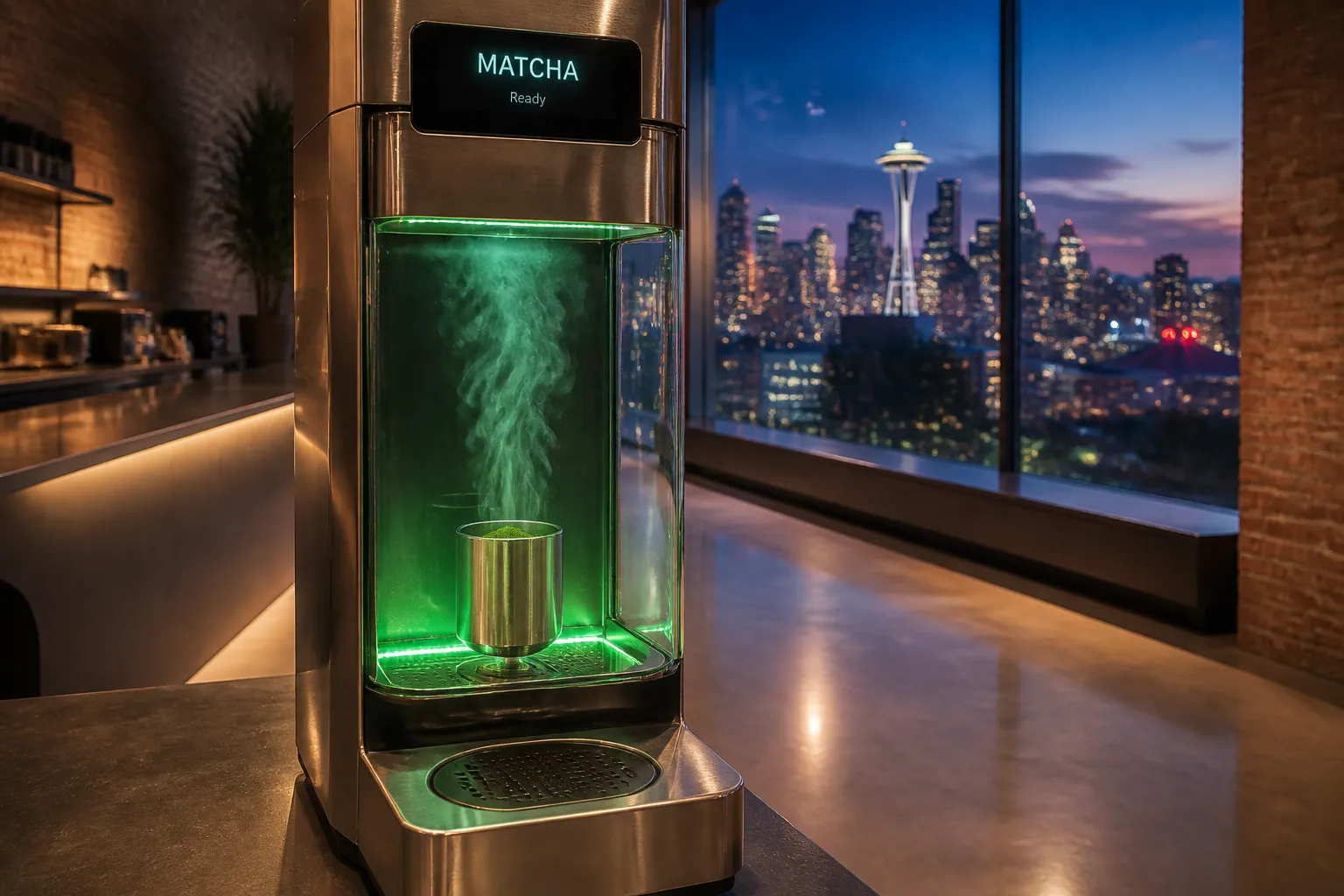
The company’s scaling strategy relies on a hybrid model that blends staffed cafés, mobile bars, and automated dispensers. A flagship dispenser sits in the lobby of an office building at 505 First Avenue South in Pioneer Square. The machine, described by Larson as a “Star Trek‑style replicator,” uses a robotic arm to pick up a cup, apply a personalized label, dispense precise ratios of matcha, oat milk, sweetener, and fruit puree, and seal the drink with a lid. A proprietary mobile app allows customers to order ahead, customize sweetness, and earn loyalty points.
Vale’s workforce is about 70 employees, split roughly evenly between front‑of‑house staff and technical talent. The leadership team includes former Axon executives: CTO Jay Reitz and Head of People and Communications Sydney Siegmeth. The company has kept its operations private for the first two years and has not yet raised venture capital.
Larson has emphasized the importance of Seattle’s talent pool, hiring former Amazon, Microsoft, and Starbucks employees. He argues that the city’s blend of creative and technical talent is essential for building a beverage brand that combines craft, hospitality, and automation.
The company’s 36,000‑square‑foot production facility south of downtown, previously occupied by Atomo Coffee, will serve as Vale’s logistical hub. The facility will support the company’s expanding supply chain as it scales its mobile and automated presence.
Vale’s mission is to offer a clean, sustained mental lift that appeals to Gen Z and Millennial consumers who are moving away from traditional coffee. The startup claims that matcha’s natural L‑theanine provides alertness without the caffeine crash, positioning it as a healthier alternative to energy drinks.
As of now, Vale has not announced any funding rounds or regulatory filings. The company’s next steps include expanding its mobile bar fleet, launching additional cafés, and deploying automated dispensers in corporate lobbies, transit hubs, and apartment complexes.
Larson’s transition from military and law‑enforcement technology to premium beverages illustrates a broader trend of tech leaders applying operational discipline to consumer brands. Whether Vale can replicate its rapid scaling model and capture a significant share of the beverage market remains to be seen, but the company’s blend of craft, technology, and local hiring is already drawing attention in Seattle’s competitive food‑tech scene.
Larson’s career began in the U.S. Marine Corps, where he completed two tours in Iraq and earned a Bronze Star with V for valor. After leaving the military, he joined Axon, a maker of Tasers and body‑worn cameras. In 2017 he was promoted to president, and during his tenure the company’s sales grew from roughly $100 million to about $1 billion. Larson also oversaw the construction of a Seattle campus that became known for its distinctive recruitment tactics and mission‑driven culture.
In 2022 Larson stepped down from Axon after a sudden health scare. He took a six‑month medical leave that extended into a two‑year sabbatical in Switzerland with his family. While recuperating, Larson was introduced to matcha by Chef Jeffrey Hayden, a Culinary Institute of America graduate who had worked in Michelin‑starred kitchens. Hayden explained that ceremonial‑grade matcha, when prepared correctly and served cold, delivers a smooth, focused experience without the jitters of coffee.
According to a GeekWire article, the conversation sparked a vision that led Larson to return to Seattle and launch Vale. The company’s headquarters are in Pioneer Square, and its first café opened in the South Lake Union neighborhood in May 2025. A second permanent location on First Hill is under development. In addition to brick‑and‑mortar sites, Vale operates a fleet of mobile matcha bars. The startup has 23 mobile units in operation this summer, with plans to expand to 100 by year‑end and 1,000 nationwide next year.
Vale’s product line is built around ceremonial‑grade matcha sourced from the Shizuoka region of Japan. Chef Hayden, who serves as Head of Craft, has worked to remove the traditional pretensions of Japanese tea ceremonies and create a menu that includes classic iced matcha, plant‑based lattes, and seasonal drinks such as a strawberry matcha latte that costs $7. The latte combines green matcha, oat milk, and a natural strawberry puree.
The company’s scaling strategy relies on a hybrid model that blends staffed cafés, mobile bars, and automated dispensers. A flagship dispenser sits in the lobby of an office building at 505 First Avenue South in Pioneer Square. The machine, described by Larson as a “Star Trek‑style replicator,” uses a robotic arm to pick up a cup, apply a personalized label, dispense precise ratios of matcha, oat milk, sweetener, and fruit puree, and seal the drink with a lid. A proprietary mobile app allows customers to order ahead, customize sweetness, and earn loyalty points.
Vale’s workforce is about 70 employees, split roughly evenly between front‑of‑house staff and technical talent. The leadership team includes former Axon executives: CTO Jay Reitz and Head of People and Communications Sydney Siegmeth. The company has kept its operations private for the first two years and has not yet raised venture capital.
Larson has emphasized the importance of Seattle’s talent pool, hiring former Amazon, Microsoft, and Starbucks employees. He argues that the city’s blend of creative and technical talent is essential for building a beverage brand that combines craft, hospitality, and automation.
The company’s 36,000‑square‑foot production facility south of downtown, previously occupied by Atomo Coffee, will serve as Vale’s logistical hub. The facility will support the company’s expanding supply chain as it scales its mobile and automated presence.
Vale’s mission is to offer a clean, sustained mental lift that appeals to Gen Z and Millennial consumers who are moving away from traditional coffee. The startup claims that matcha’s natural L‑theanine provides alertness without the caffeine crash, positioning it as a healthier alternative to energy drinks.
As of now, Vale has not announced any funding rounds or regulatory filings. The company’s next steps include expanding its mobile bar fleet, launching additional cafés, and deploying automated dispensers in corporate lobbies, transit hubs, and apartment complexes.
Larson’s transition from military and law‑enforcement technology to premium beverages illustrates a broader trend of tech leaders applying operational discipline to consumer brands. Whether Vale can replicate its rapid scaling model and capture a significant share of the beverage market remains to be seen, but the company’s blend of craft, technology, and local hiring is already drawing attention in Seattle’s competitive food‑tech scene.








