Blab Tech
Home-Cleanup Robot Stringman Uses Cable-Suspended Crane to Pick Up Household Mess
When a father of three and an engineer finally solved the perennial problem of scattered toys and socks, he didn’t settle for a conventional vacuum or a robot vacuum. In 2026, Nathaniel Nifong launched the Stringman robot—a cable‑suspended crane that glides over a room, spots loose items, and lifts them to a designated drop‑off point.
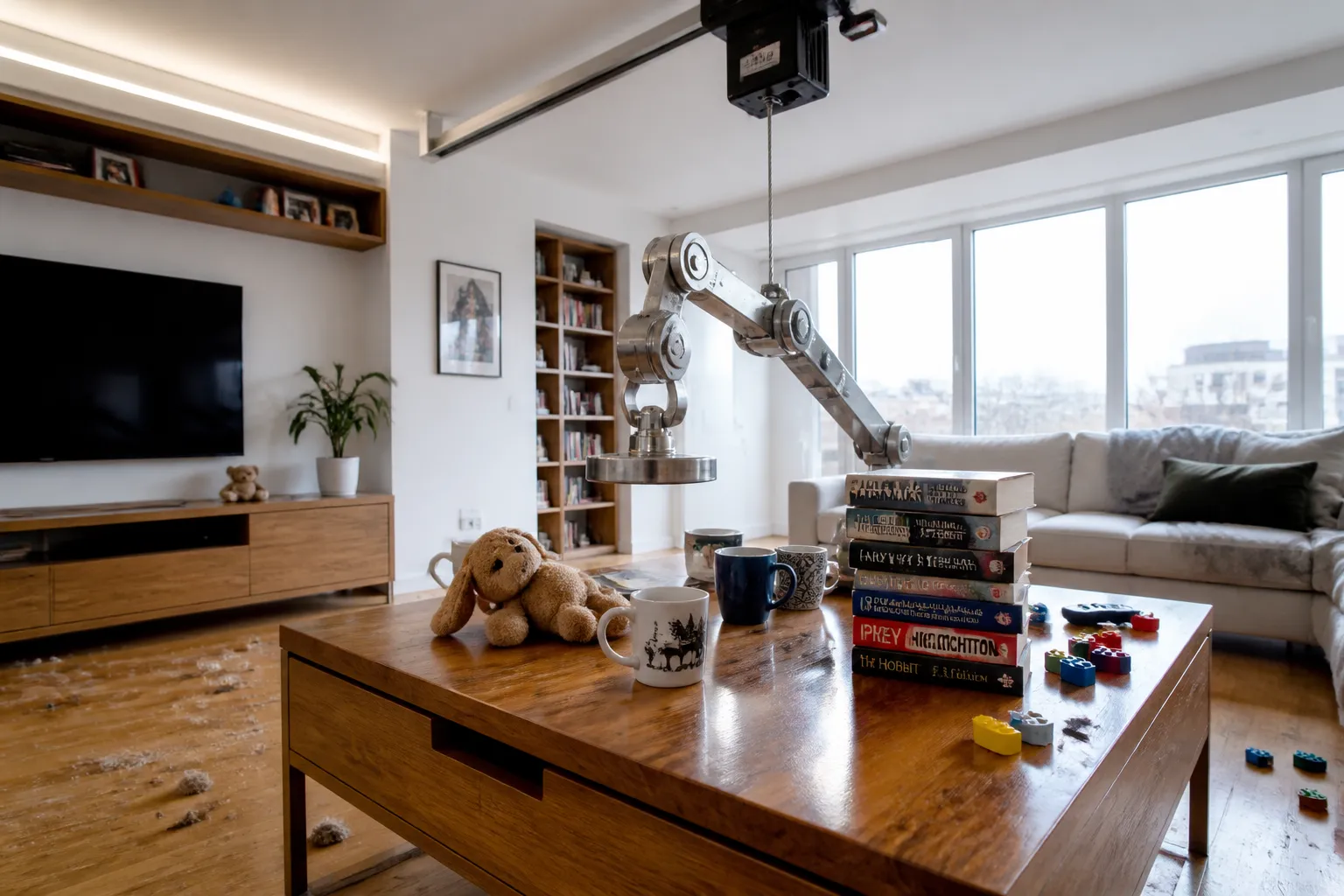
The system’s core is a quartet of steel cables anchored at each corner of a room. Motorized spools reel the cables in and out, allowing a gripper to move freely in three dimensions across the ceiling. The design echoes an industrial overhead crane but is scaled down for domestic use, giving Stringman the reach of a warehouse robot without the bulk of fixed rails.
Stringman can run for roughly an hour on a single charge. During that time it scans the room, identifies objects, and transports them to a pre‑set bin. Vision is powered by a diffusion transformer model that processes images from a camera mounted on the crane. The model has been trained to recognize common household items such as toys, clothing, and small debris.
The firmware, released under the Apache 2.0 license, is written in Python and runs on a Raspberry Pi. Nifong’s GitHub repository contains the full code, a list of required components, and 3‑D printable parts for the gripper and mounting hardware. The project is open‑source, and build instructions are posted on GitHub, while a pilot run of ready‑to‑use hardware kits is available through Nifong’s company website.
Despite its promise, Stringman has limitations. The gripper struggles with heavier or irregularly shaped items—books, for example, can slip or cause the gripper to lose grip. The vision model is still in early stages; it sometimes misidentifies objects or fails to detect items that are partially obscured. In addition, the cables can sag during operation, creating a potential tripping hazard in a busy household.
Compared to a traditional bridge crane, the cable‑suspended design offers greater flexibility in a small space. An overhead crane requires fixed rails or supports, whereas the Stringman system can be installed on any ceiling with minimal structural modification. However, the lack of a rigid rail means the crane is more susceptible to cable vibration and requires careful calibration to maintain stability.
Nifong has hinted that future iterations may include a secondary system to place items in their proper storage locations rather than simply dropping them into a bin. This would require additional manipulation capabilities and more advanced object‑recognition algorithms. The open‑source nature of the project means that developers and hobbyists can experiment with these enhancements.
Today, the Stringman robot is available as a DIY kit that includes all necessary hardware and a detailed assembly guide. Pilot hardware kits sold through the company website provide a ready‑to‑operate unit for users who prefer not to build from scratch. The project has attracted interest from the maker community, but no commercial production line has yet been announced.
In sum, the Stringman robot demonstrates a practical application of cable‑suspended robotics for domestic cleanup. It combines an open‑source firmware stack, a diffusion‑transformer vision model, and a simple mechanical design to create a system that can operate autonomously for an hour. While the current version has limitations in gripper performance and vision accuracy, the project’s modularity and community support suggest that further refinements could bring it closer to a fully automated household assistant.
The system’s core is a quartet of steel cables anchored at each corner of a room. Motorized spools reel the cables in and out, allowing a gripper to move freely in three dimensions across the ceiling. The design echoes an industrial overhead crane but is scaled down for domestic use, giving Stringman the reach of a warehouse robot without the bulk of fixed rails.
Stringman can run for roughly an hour on a single charge. During that time it scans the room, identifies objects, and transports them to a pre‑set bin. Vision is powered by a diffusion transformer model that processes images from a camera mounted on the crane. The model has been trained to recognize common household items such as toys, clothing, and small debris.
The firmware, released under the Apache 2.0 license, is written in Python and runs on a Raspberry Pi. Nifong’s GitHub repository contains the full code, a list of required components, and 3‑D printable parts for the gripper and mounting hardware. The project is open‑source, and build instructions are posted on GitHub, while a pilot run of ready‑to‑use hardware kits is available through Nifong’s company website.
Despite its promise, Stringman has limitations. The gripper struggles with heavier or irregularly shaped items—books, for example, can slip or cause the gripper to lose grip. The vision model is still in early stages; it sometimes misidentifies objects or fails to detect items that are partially obscured. In addition, the cables can sag during operation, creating a potential tripping hazard in a busy household.
Compared to a traditional bridge crane, the cable‑suspended design offers greater flexibility in a small space. An overhead crane requires fixed rails or supports, whereas the Stringman system can be installed on any ceiling with minimal structural modification. However, the lack of a rigid rail means the crane is more susceptible to cable vibration and requires careful calibration to maintain stability.
Nifong has hinted that future iterations may include a secondary system to place items in their proper storage locations rather than simply dropping them into a bin. This would require additional manipulation capabilities and more advanced object‑recognition algorithms. The open‑source nature of the project means that developers and hobbyists can experiment with these enhancements.
Today, the Stringman robot is available as a DIY kit that includes all necessary hardware and a detailed assembly guide. Pilot hardware kits sold through the company website provide a ready‑to‑operate unit for users who prefer not to build from scratch. The project has attracted interest from the maker community, but no commercial production line has yet been announced.
In sum, the Stringman robot demonstrates a practical application of cable‑suspended robotics for domestic cleanup. It combines an open‑source firmware stack, a diffusion‑transformer vision model, and a simple mechanical design to create a system that can operate autonomously for an hour. While the current version has limitations in gripper performance and vision accuracy, the project’s modularity and community support suggest that further refinements could bring it closer to a fully automated household assistant.








