Blab Tech
DIY AirSense Smart Air Purifier Combines Sensors, Cloud Connectivity, and Custom Design
When a room’s air quality becomes a data point, the AirSense project turns the ordinary act of breathing into a measurable, controllable experience.
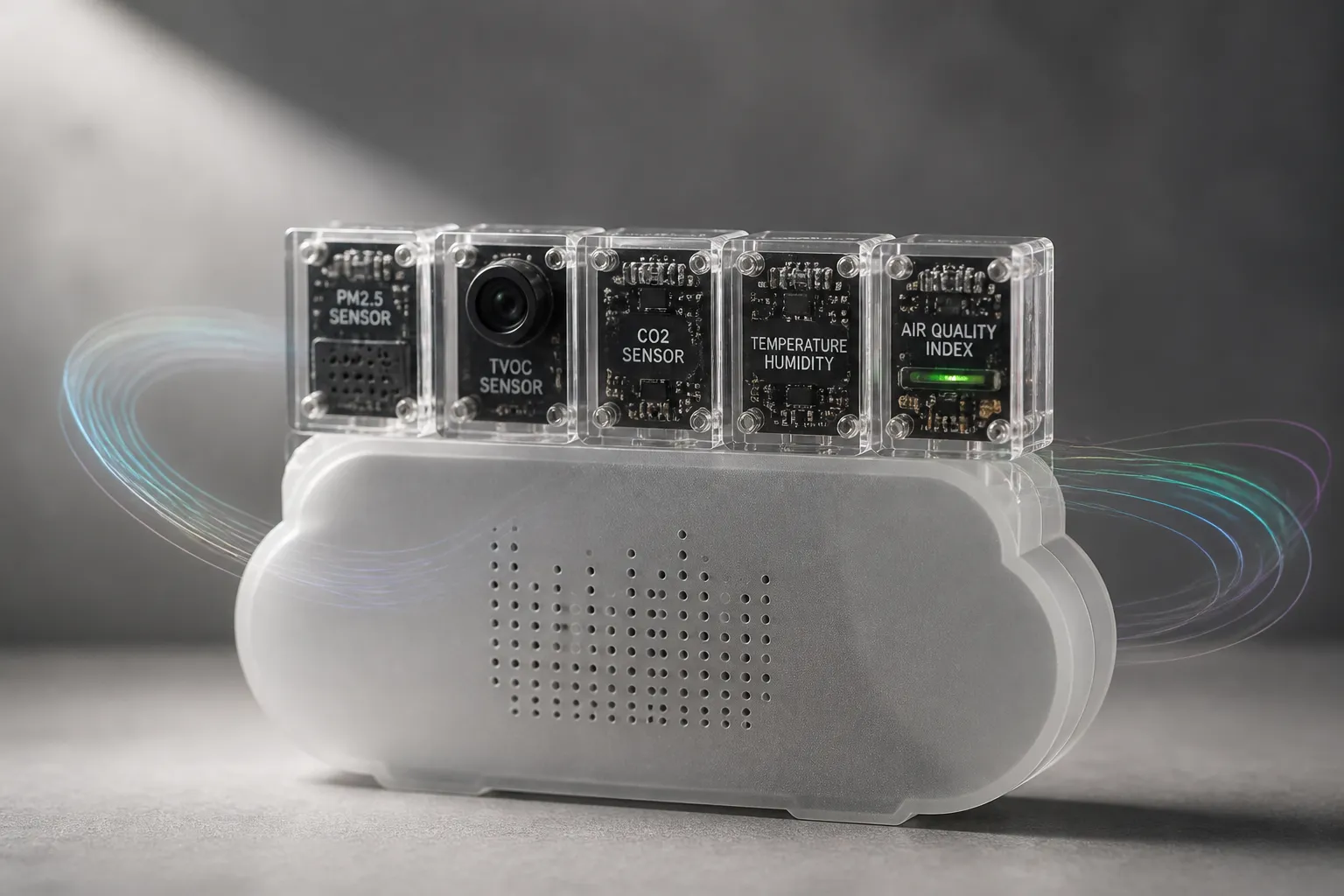
Built around the Waveshare ESP32‑S3 development board, AirSense fuses environmental sensing, filtration, and cloud‑based control into a single, self‑assembled unit. The BME680 sensor reports temperature, humidity, pressure, and gas resistance, while a separate dust sensor tracks PM2.5 levels. A relay‑controlled 150 mm exhaust fan pulls air through a Xiaomi HEPA filter, and the whole system is housed in a 3‑D printed enclosure designed in Autodesk Fusion 360. From a smartphone, users can view live data on an LCD screen and toggle the fan on or off via the Arduino IoT Cloud.
Indoor air quality has moved from a niche concern to a public health priority, yet most commercial purifiers are expensive, inflexible, and opaque about the air they clean. AirSense bridges that gap by displaying real‑time AQI, particulate concentration, temperature, humidity, and pressure on a front‑mounted LCD. The same metrics stream to the cloud, where gauges and a remote switch appear in the Arduino Remote app or a web dashboard.
The design journey began with a Fusion 360 model that neatly accommodates the HEPA filter, fan, ESP32‑S3, BME680, dust sensor, relay module, and a 5 V SMPS derived from a repurposed smartphone charger. A twist‑lock enclosure eliminates screws and gives the device a finished look. Assembly involves removing the fan housing, mounting the motor and blade onto a 3‑D printed mount, inserting a TPU gasket between the filter base and bottom plate, and securing the filter to a stainless‑steel dustbin. The relay connects to the fan’s live and neutral lines, and the ESP32 drives it through a GPIO pin.
Connectivity is handled through the Arduino IoT Cloud. The maker defines a new “Thing” with five cloud variables—AQI, dust (PM2.5), temperature, humidity, and power. The ESP32 firmware, written in the Arduino IDE, pulls in libraries such as TFT_eSPI, LVGL, Adafruit BME680, and ArduinoIoTCloud. After entering Wi‑Fi credentials and the device’s secret key, the firmware uploads to the board, and the purifier automatically joins the cloud network. From there, users can open the Arduino Remote app or a web dashboard to monitor readings and control the fan.
AirSense demonstrates that makers can create cost‑effective, intelligent devices by combining open‑source hardware, 3‑D printed enclosures, and cloud services. By publishing design files and a step‑by‑step assembly guide, the creator invites others to replicate or customize the system for their own needs. The project is not a commercial launch but a proof of concept that low‑cost sensors, a microcontroller, and cloud connectivity can deliver a functional indoor air quality monitor.
In short, AirSense is a fully documented DIY smart air purifier that integrates an ESP32‑S3, BME680, dust sensor, and Xiaomi HEPA filter inside a Fusion 360‑designed enclosure. The device streams data to the Arduino IoT Cloud and can be controlled remotely via a smartphone. Design files and assembly instructions are publicly available, enabling makers to build and adapt the system. The project highlights the growing maker‑driven IoT trend that delivers real‑time environmental data and remote control without the price tag or complexity of commercial purifiers.
Built around the Waveshare ESP32‑S3 development board, AirSense fuses environmental sensing, filtration, and cloud‑based control into a single, self‑assembled unit. The BME680 sensor reports temperature, humidity, pressure, and gas resistance, while a separate dust sensor tracks PM2.5 levels. A relay‑controlled 150 mm exhaust fan pulls air through a Xiaomi HEPA filter, and the whole system is housed in a 3‑D printed enclosure designed in Autodesk Fusion 360. From a smartphone, users can view live data on an LCD screen and toggle the fan on or off via the Arduino IoT Cloud.
Indoor air quality has moved from a niche concern to a public health priority, yet most commercial purifiers are expensive, inflexible, and opaque about the air they clean. AirSense bridges that gap by displaying real‑time AQI, particulate concentration, temperature, humidity, and pressure on a front‑mounted LCD. The same metrics stream to the cloud, where gauges and a remote switch appear in the Arduino Remote app or a web dashboard.
The design journey began with a Fusion 360 model that neatly accommodates the HEPA filter, fan, ESP32‑S3, BME680, dust sensor, relay module, and a 5 V SMPS derived from a repurposed smartphone charger. A twist‑lock enclosure eliminates screws and gives the device a finished look. Assembly involves removing the fan housing, mounting the motor and blade onto a 3‑D printed mount, inserting a TPU gasket between the filter base and bottom plate, and securing the filter to a stainless‑steel dustbin. The relay connects to the fan’s live and neutral lines, and the ESP32 drives it through a GPIO pin.
Connectivity is handled through the Arduino IoT Cloud. The maker defines a new “Thing” with five cloud variables—AQI, dust (PM2.5), temperature, humidity, and power. The ESP32 firmware, written in the Arduino IDE, pulls in libraries such as TFT_eSPI, LVGL, Adafruit BME680, and ArduinoIoTCloud. After entering Wi‑Fi credentials and the device’s secret key, the firmware uploads to the board, and the purifier automatically joins the cloud network. From there, users can open the Arduino Remote app or a web dashboard to monitor readings and control the fan.
AirSense demonstrates that makers can create cost‑effective, intelligent devices by combining open‑source hardware, 3‑D printed enclosures, and cloud services. By publishing design files and a step‑by‑step assembly guide, the creator invites others to replicate or customize the system for their own needs. The project is not a commercial launch but a proof of concept that low‑cost sensors, a microcontroller, and cloud connectivity can deliver a functional indoor air quality monitor.
In short, AirSense is a fully documented DIY smart air purifier that integrates an ESP32‑S3, BME680, dust sensor, and Xiaomi HEPA filter inside a Fusion 360‑designed enclosure. The device streams data to the Arduino IoT Cloud and can be controlled remotely via a smartphone. Design files and assembly instructions are publicly available, enabling makers to build and adapt the system. The project highlights the growing maker‑driven IoT trend that delivers real‑time environmental data and remote control without the price tag or complexity of commercial purifiers.