Blab Tech
Nvidias Unreleased RTX 3050 Ti Desktop Prototype Revealed by Hardware Leaker
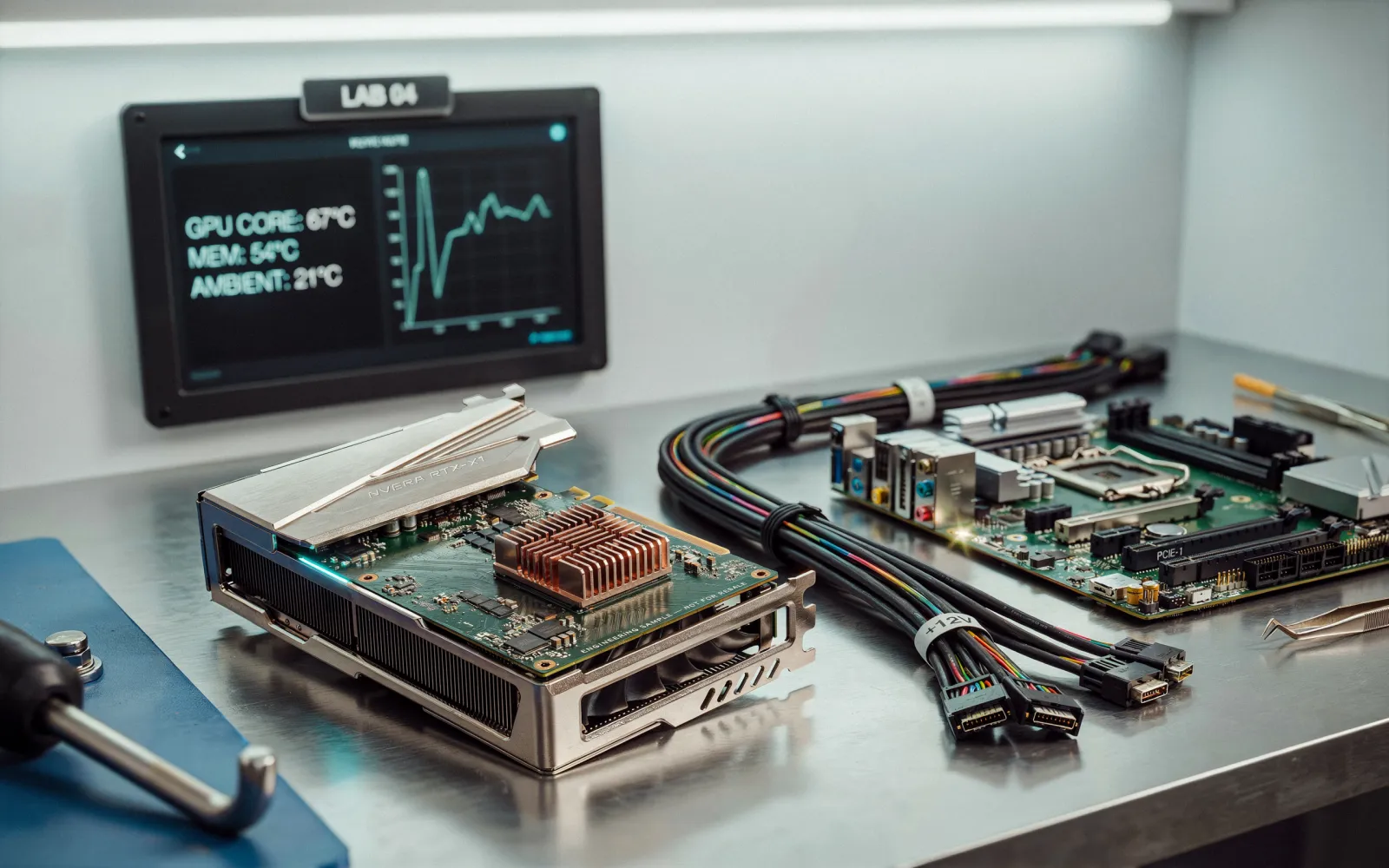
A secret prototype of Nvidia’s RTX 3050 Ti has slipped into the public eye, courtesy of hardware leaker Gok. The card, captured in a series of photographs and benchmarked by the leaker, confirms that Nvidia reached at least the prototype stage for a desktop variant that never hit shelves.
The sample is said to come from a company called Robiny and is built on the PG190 SKU 40 design board. It uses Nvidia’s Ampere architecture and the GA106 silicon die that also powers the RTX 3050 and RTX 3060 desktop GPUs. The die, 276 mm² in size and fabricated on Samsung’s 8N process, contains 12 billion transistors.
Core counts are a key differentiator. The RTX 3050 Ti employs 26 streaming multiprocessors (SMs), which is 87 % of the 30 SMs available on a full‑sized GA106 die. This yields 3,328 CUDA cores, 104 Tensor cores, and 26 RT cores. The base clock sits at 1,410 MHz and the boost clock at 1,665 MHz—higher than the RTX 3060’s clocks but lower than those on the RTX 3050.
Memory on the prototype is 6 GB of GDDR6, running at 14 Gb/s over a 192‑bit bus. The resulting bandwidth is 336 GB/s, 50 % above the RTX 3050’s 224 GB/s and 7 % below the RTX 3060’s 360 GB/s. The 6 GB capacity is half the 12 GB found on the RTX 3060 and 2 GB less than the 8 GB on the RTX 3050.
Gok’s benchmark data shows the card scoring 7,787 points in 3DMark’s Time Spy test. For context, the RTX 3060 typically scores between 8,200 and 9,000 points, while the RTX 3050 ranges from 5,300 to 6,400. Using the upper figures, the RTX 3050 Ti would be roughly 13 % slower than the RTX 3060 and up to 22 % faster than the RTX 3050.
Nvidia has only released the RTX 3050 Ti in laptop form, based on the GA107 die. The desktop version never entered the market, likely because supply constraints that plagued the Ampere launch—fuelled by a cryptocurrency mining boom and the COVID‑19 pandemic—limited Nvidia’s ability to ship new models between 2020 and 2022.
Had the desktop RTX 3050 Ti been released, it would have bridged the price gap between the RTX 3050 ($249) and the RTX 3060 ($329). A $289 MSRP would have positioned it as a mid‑range option for budget gamers. Today, the RTX 3060 remains the most popular desktop card on Steam, and newer custom RTX 3060 models start at $479.
The prototype illustrates Nvidia’s strategy of recycling high‑end silicon for different market segments. By de‑scaling the GA106 die, the company can offer a spectrum of performance levels without developing new architectures.
No official statement from Nvidia confirms the prototype’s status or future plans. The leaked images and benchmark results are the only publicly available evidence of the desktop RTX 3050 Ti.
In short, the leak confirms that Nvidia produced a desktop RTX 3050 Ti based on the GA106 die, featuring 3,328 CUDA cores, 6 GB of GDDR6, and a 192‑bit memory bus. The card sits between the RTX 3050 and RTX 3060 in performance and memory, but it never reached production. The leak offers insight into Nvidia’s product strategy during the Ampere era and highlights the challenges of launching new GPUs amid global supply constraints.
The sample is said to come from a company called Robiny and is built on the PG190 SKU 40 design board. It uses Nvidia’s Ampere architecture and the GA106 silicon die that also powers the RTX 3050 and RTX 3060 desktop GPUs. The die, 276 mm² in size and fabricated on Samsung’s 8N process, contains 12 billion transistors.
Core counts are a key differentiator. The RTX 3050 Ti employs 26 streaming multiprocessors (SMs), which is 87 % of the 30 SMs available on a full‑sized GA106 die. This yields 3,328 CUDA cores, 104 Tensor cores, and 26 RT cores. The base clock sits at 1,410 MHz and the boost clock at 1,665 MHz—higher than the RTX 3060’s clocks but lower than those on the RTX 3050.
Memory on the prototype is 6 GB of GDDR6, running at 14 Gb/s over a 192‑bit bus. The resulting bandwidth is 336 GB/s, 50 % above the RTX 3050’s 224 GB/s and 7 % below the RTX 3060’s 360 GB/s. The 6 GB capacity is half the 12 GB found on the RTX 3060 and 2 GB less than the 8 GB on the RTX 3050.
Gok’s benchmark data shows the card scoring 7,787 points in 3DMark’s Time Spy test. For context, the RTX 3060 typically scores between 8,200 and 9,000 points, while the RTX 3050 ranges from 5,300 to 6,400. Using the upper figures, the RTX 3050 Ti would be roughly 13 % slower than the RTX 3060 and up to 22 % faster than the RTX 3050.
Nvidia has only released the RTX 3050 Ti in laptop form, based on the GA107 die. The desktop version never entered the market, likely because supply constraints that plagued the Ampere launch—fuelled by a cryptocurrency mining boom and the COVID‑19 pandemic—limited Nvidia’s ability to ship new models between 2020 and 2022.
Had the desktop RTX 3050 Ti been released, it would have bridged the price gap between the RTX 3050 ($249) and the RTX 3060 ($329). A $289 MSRP would have positioned it as a mid‑range option for budget gamers. Today, the RTX 3060 remains the most popular desktop card on Steam, and newer custom RTX 3060 models start at $479.
The prototype illustrates Nvidia’s strategy of recycling high‑end silicon for different market segments. By de‑scaling the GA106 die, the company can offer a spectrum of performance levels without developing new architectures.
No official statement from Nvidia confirms the prototype’s status or future plans. The leaked images and benchmark results are the only publicly available evidence of the desktop RTX 3050 Ti.
In short, the leak confirms that Nvidia produced a desktop RTX 3050 Ti based on the GA106 die, featuring 3,328 CUDA cores, 6 GB of GDDR6, and a 192‑bit memory bus. The card sits between the RTX 3050 and RTX 3060 in performance and memory, but it never reached production. The leak offers insight into Nvidia’s product strategy during the Ampere era and highlights the challenges of launching new GPUs amid global supply constraints.