Blab Tech
Global Agritech Investment Reaches $16 billion as AI and Genetics Drive Precision Farming
When the world’s food systems feel the tremors of war, pandemic, and climate change, a quiet revolution unfolds in the fields. In 2025, venture capitalists poured a record $16 billion into agritech, a figure that eclipses the $9 billion earmarked for yield‑boosting research alone—a dramatic jump from the $2.5 billion invested in 2016.
The surge is not accidental. Supply chains have been rattled by the COVID‑19 pandemic, the war in Ukraine, and a new conflict in the Middle East, while droughts, soil salinisation, and extreme weather add fresh pressure. Since the Green Revolution of the mid‑20th century, the fundamentals of food production have remained largely unchanged, leaving room for technology to intervene.
“Volatility is very bad for people who want to eat, but good for tech adoption,” said Adam Anders, managing partner at Dutch venture‑capital firm Anterra Capital. At the F&A Next conference held last month at Wageningen University & Research, more than 600 ag‑tech investors and 200 startups convened. Themes that emerged included pesticides that mimic natural molecules and the tailoring of fertilizers and other crop aids to the genetics of individual fields.
Cindy Gerhardt of Planet‑B.io, a Dutch industrial‑biotech accelerator, framed the conversation around sustainability: the focus has shifted from “preventing climate change” to “dealing with it and finding solutions, because otherwise prices are going to rise too high.” One illustration is B‑COS, a spin‑out from Ghent University that genetically engineers bacteria to produce molecules similar to chitin. When sprayed on tomato and potato plants, the molecules trigger the plants’ natural defence mechanisms. B‑COS is testing two new products: one aimed at improving growth and drought tolerance, and another that it claims can reduce disease by 40‑50 %.
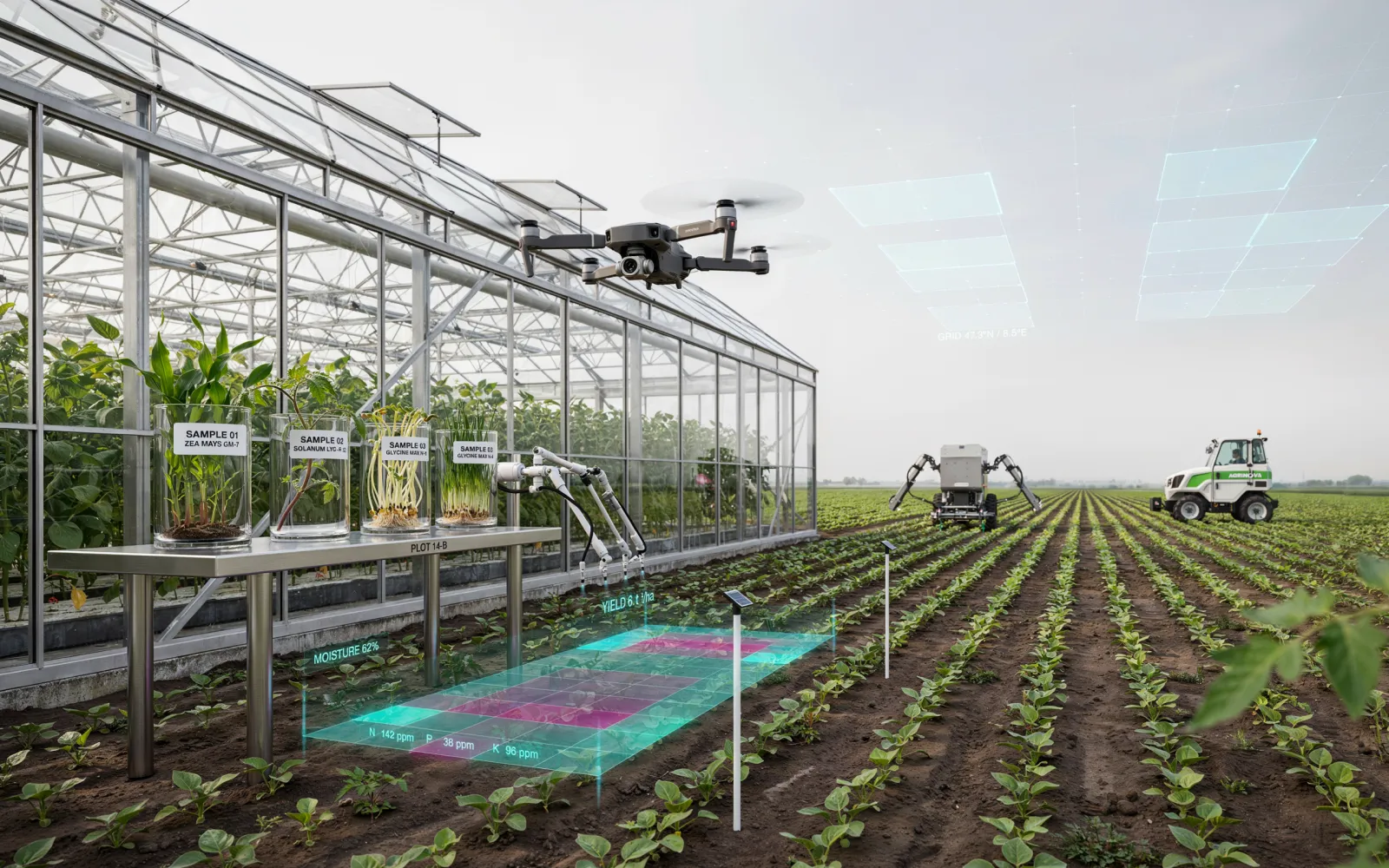
Artificial intelligence is accelerating the shift toward precision agriculture. By linking data from every square metre of a field to weather forecasts, carbon capture metrics, and consumer demand, AI enables farmers to make granular decisions. The approach involves collecting vast amounts of data on environmental conditions, soil microbes, and plant genetics, then running the data through algorithms that predict optimal treatments.
EVJA, an Italian company, uses field‑based sensors to gather local environmental data. The data feed an AI model that predicts the risk of mildew, grey mould, and other diseases, and also forecasts crop yields, water demand, and carbon emissions. Chief executive Davide Parisi says clients have reduced water and fertilizer use by up to 40 % while boosting yields of leafy greens, tomatoes, and potatoes.
Soilytix, a Hamburg‑based biotech firm, takes a similar approach underground. By analysing the DNA of soil microbes, it identifies pathogens and sends farmers recommendations for seed varieties and pesticide adjustments. Like EVJA, Soilytix also measures carbon sequestration in a plot.
Other startups are applying advanced breeding and digital tools to produce more nutritious, climate‑resilient crops. Pádraic Flood, a plant geneticist, founded Aardaia on the Wageningen campus. The company domesticates the aardaker, a wild “protein potato,” and uses speed‑breeding in growth chambers to produce five generations per year. Machine learning matches genetic data to yield, flavour, and protein content, and Flood reports varieties that produce tubers with yields around ten times that of wild plants.
Radicle Crops, a Dutch startup, focuses on quinoa, a high‑protein crop that contains all nine essential amino acids. The company is developing climate‑resilient varieties and has begun a commercial rollout of a hybrid that yields 25‑45 % more grain than previous varieties.
Despite the investment surge, agritech startups attracted only 1.3 % of global early‑stage venture‑capital funding in 2024—a figure that reflects the uneven distribution of high‑tech innovations, which tend to reach developed markets first.
In short, the 2025 agritech funding round of $16 billion underscores a growing confidence that AI and genetics can usher in a new era of precision farming. While startups like B‑COS, EVJA, Soilytix, Aardaia, and Radicle Crops are pushing the boundaries of crop resilience and productivity, agritech remains a modest slice of the overall venture‑capital pie. Continued funding, regulatory support, and technological breakthroughs will determine whether this nascent sector can deliver the food‑security gains it promises.
The surge is not accidental. Supply chains have been rattled by the COVID‑19 pandemic, the war in Ukraine, and a new conflict in the Middle East, while droughts, soil salinisation, and extreme weather add fresh pressure. Since the Green Revolution of the mid‑20th century, the fundamentals of food production have remained largely unchanged, leaving room for technology to intervene.
“Volatility is very bad for people who want to eat, but good for tech adoption,” said Adam Anders, managing partner at Dutch venture‑capital firm Anterra Capital. At the F&A Next conference held last month at Wageningen University & Research, more than 600 ag‑tech investors and 200 startups convened. Themes that emerged included pesticides that mimic natural molecules and the tailoring of fertilizers and other crop aids to the genetics of individual fields.
Cindy Gerhardt of Planet‑B.io, a Dutch industrial‑biotech accelerator, framed the conversation around sustainability: the focus has shifted from “preventing climate change” to “dealing with it and finding solutions, because otherwise prices are going to rise too high.” One illustration is B‑COS, a spin‑out from Ghent University that genetically engineers bacteria to produce molecules similar to chitin. When sprayed on tomato and potato plants, the molecules trigger the plants’ natural defence mechanisms. B‑COS is testing two new products: one aimed at improving growth and drought tolerance, and another that it claims can reduce disease by 40‑50 %.
Artificial intelligence is accelerating the shift toward precision agriculture. By linking data from every square metre of a field to weather forecasts, carbon capture metrics, and consumer demand, AI enables farmers to make granular decisions. The approach involves collecting vast amounts of data on environmental conditions, soil microbes, and plant genetics, then running the data through algorithms that predict optimal treatments.
EVJA, an Italian company, uses field‑based sensors to gather local environmental data. The data feed an AI model that predicts the risk of mildew, grey mould, and other diseases, and also forecasts crop yields, water demand, and carbon emissions. Chief executive Davide Parisi says clients have reduced water and fertilizer use by up to 40 % while boosting yields of leafy greens, tomatoes, and potatoes.
Soilytix, a Hamburg‑based biotech firm, takes a similar approach underground. By analysing the DNA of soil microbes, it identifies pathogens and sends farmers recommendations for seed varieties and pesticide adjustments. Like EVJA, Soilytix also measures carbon sequestration in a plot.
Other startups are applying advanced breeding and digital tools to produce more nutritious, climate‑resilient crops. Pádraic Flood, a plant geneticist, founded Aardaia on the Wageningen campus. The company domesticates the aardaker, a wild “protein potato,” and uses speed‑breeding in growth chambers to produce five generations per year. Machine learning matches genetic data to yield, flavour, and protein content, and Flood reports varieties that produce tubers with yields around ten times that of wild plants.
Radicle Crops, a Dutch startup, focuses on quinoa, a high‑protein crop that contains all nine essential amino acids. The company is developing climate‑resilient varieties and has begun a commercial rollout of a hybrid that yields 25‑45 % more grain than previous varieties.
Despite the investment surge, agritech startups attracted only 1.3 % of global early‑stage venture‑capital funding in 2024—a figure that reflects the uneven distribution of high‑tech innovations, which tend to reach developed markets first.
In short, the 2025 agritech funding round of $16 billion underscores a growing confidence that AI and genetics can usher in a new era of precision farming. While startups like B‑COS, EVJA, Soilytix, Aardaia, and Radicle Crops are pushing the boundaries of crop resilience and productivity, agritech remains a modest slice of the overall venture‑capital pie. Continued funding, regulatory support, and technological breakthroughs will determine whether this nascent sector can deliver the food‑security gains it promises.








