Blab Tech
Punjabi University Researcher Advances 6G Terahertz Antenna Design
In a breakthrough that could bring the next generation of mobile networks closer to reality, Nipun Sharma, a researcher in Punjabi University’s Department of Electronics and Communication Engineering, has released a graphene‑based terahertz patch antenna that outperforms existing designs. Supervised by Professor Amrit Kaur, the work appears in three SCI‑indexed journals, two Scopus‑indexed journals, two conference proceedings and an additional peer‑reviewed journal, underscoring its rigorous peer‑reviewed status.
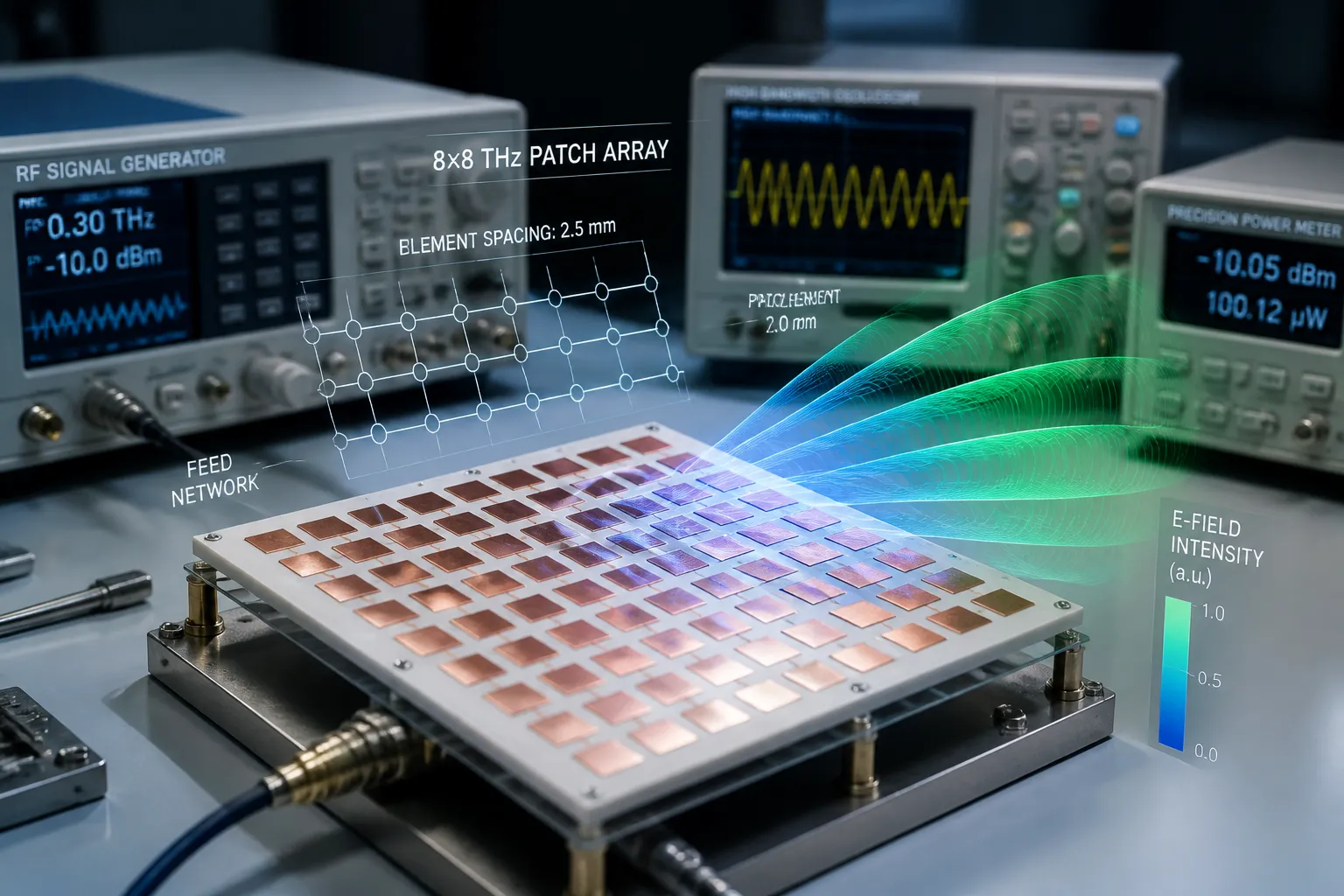
The antenna is a microstrip patch built from graphene, a material celebrated for its high electron mobility and tunable conductivity. Operating in the terahertz band—a frequency range earmarked for 6G’s promised multi‑terabit‑per‑second data rates—the design delivers superior return loss, bandwidth, efficiency and gain compared to current terahertz antennas. Sharma explained that these gains stem from the application of meta‑heuristic optimization algorithms during the design process.
"The antenna requires micrometre‑level fabrication, which aligns with the rapid growth of India’s semiconductor sector," Professor Kaur noted. She added that the new design could enable on‑chip terahertz antennas to be manufactured domestically, marking a milestone for high‑technology communication systems and terahertz applications in India.
Vice‑chancellor Jagdeep Singh welcomed the achievement, calling it a major step toward self‑reliance in India’s technology sector. He said the research enhances Punjabi University’s academic reputation and could inspire other researchers.
This work fits into a broader push toward 6G, which is expected to harness terahertz frequencies to deliver unprecedented data rates. The International Telecommunication Union’s IMT‑2030 framework is guiding global standardization, while companies such as Ericsson, Nokia, Huawei and Samsung invest heavily in 6G research. India’s Digital India initiative and its focus on semiconductor manufacturing provide a supportive policy backdrop for domestic development of terahertz components.
Graphene’s two‑dimensional structure allows for compact, low‑loss designs—a key advantage at terahertz frequencies. The research team combined simulation tools with machine‑learning‑based meta‑heuristics to optimize the patch geometry and material parameters.
While the design has shown promising simulation results, the next step will be experimental validation. The team plans to fabricate prototypes using advanced lithography techniques and measure key performance metrics such as return loss and gain in a controlled laboratory environment.
The publication of these findings in multiple international journals signals that the work has undergone peer review and has been deemed a contribution to the field of terahertz antenna research. No commercial product has yet been announced, and the technology remains in the research and development phase.
In the coming months, Punjabi University researchers will likely focus on prototype fabrication and testing. If successful, the design could be integrated into on‑chip antenna arrays for 6G base stations or user equipment, potentially reducing reliance on imported components. The research also aligns with India’s broader goal of achieving greater self‑sufficiency in advanced semiconductor and communication technologies.
At present, the antenna design remains a laboratory achievement, but its publication and the recognition from university leadership suggest that it could play a role in India’s future 6G infrastructure. Further studies will determine whether the design can be scaled for mass production and whether it meets the stringent reliability and cost requirements of commercial telecommunications equipment.
The antenna is a microstrip patch built from graphene, a material celebrated for its high electron mobility and tunable conductivity. Operating in the terahertz band—a frequency range earmarked for 6G’s promised multi‑terabit‑per‑second data rates—the design delivers superior return loss, bandwidth, efficiency and gain compared to current terahertz antennas. Sharma explained that these gains stem from the application of meta‑heuristic optimization algorithms during the design process.
"The antenna requires micrometre‑level fabrication, which aligns with the rapid growth of India’s semiconductor sector," Professor Kaur noted. She added that the new design could enable on‑chip terahertz antennas to be manufactured domestically, marking a milestone for high‑technology communication systems and terahertz applications in India.
Vice‑chancellor Jagdeep Singh welcomed the achievement, calling it a major step toward self‑reliance in India’s technology sector. He said the research enhances Punjabi University’s academic reputation and could inspire other researchers.
This work fits into a broader push toward 6G, which is expected to harness terahertz frequencies to deliver unprecedented data rates. The International Telecommunication Union’s IMT‑2030 framework is guiding global standardization, while companies such as Ericsson, Nokia, Huawei and Samsung invest heavily in 6G research. India’s Digital India initiative and its focus on semiconductor manufacturing provide a supportive policy backdrop for domestic development of terahertz components.
Graphene’s two‑dimensional structure allows for compact, low‑loss designs—a key advantage at terahertz frequencies. The research team combined simulation tools with machine‑learning‑based meta‑heuristics to optimize the patch geometry and material parameters.
While the design has shown promising simulation results, the next step will be experimental validation. The team plans to fabricate prototypes using advanced lithography techniques and measure key performance metrics such as return loss and gain in a controlled laboratory environment.
The publication of these findings in multiple international journals signals that the work has undergone peer review and has been deemed a contribution to the field of terahertz antenna research. No commercial product has yet been announced, and the technology remains in the research and development phase.
In the coming months, Punjabi University researchers will likely focus on prototype fabrication and testing. If successful, the design could be integrated into on‑chip antenna arrays for 6G base stations or user equipment, potentially reducing reliance on imported components. The research also aligns with India’s broader goal of achieving greater self‑sufficiency in advanced semiconductor and communication technologies.
At present, the antenna design remains a laboratory achievement, but its publication and the recognition from university leadership suggest that it could play a role in India’s future 6G infrastructure. Further studies will determine whether the design can be scaled for mass production and whether it meets the stringent reliability and cost requirements of commercial telecommunications equipment.