Blab Tech
Fujitsu and Nvidia Announce Collaboration to Advance Japans Physical AI Robotics
In Tokyo on July 12, 2026, Fujitsu Limited and Nvidia Corporation unveiled a joint effort to bring what the companies call "physical AI" to Japan—robots that learn and adapt to their surroundings instead of following rigid scripts. The announcement was made alongside the CEOs of the nation’s leading industrial‑robot makers, Fanuc Corp., Yaskawa Electric Corp. and Kawasaki Heavy Industries.
The partnership builds on a technology‑infrastructure deal signed between Fujitsu and Nvidia last year. According to the AP, the new initiative will fuse Nvidia’s GPU‑based AI platforms with Fujitsu’s manufacturing know‑how and digital‑twins technology. The goal is to create robots that can operate safely beside humans in factories, homes and hospitals, a capability that could help offset Japan’s acute labor shortage and aging population.
"Physical AI is a good fit for Japan because of the country’s reputation for manufacturing quality," Nvidia CEO Jensen Huang said at the event. He highlighted Japan’s culture of continuous improvement—kaizen—as a foundation for developing precise, reliable robots. Fujitsu CEO Takahito Tokita added that the collaboration would leverage the country’s strengths in robotics and AI to produce solutions that meet high safety and performance standards.
The companies did not set a specific launch date for the robots. They said the first phase of the collaboration would begin later in 2026, with no decision yet on a joint venture. The announcement follows the Japanese government’s plan, announced by Prime Minister Sanae Takaichi, to invest more than 370 trillion yen ($2.3 trillion) in technology fields including physical AI, semiconductors and data centers by 2040.
Nvidia’s open‑source AI tools have been used in a range of Japanese partnerships, including with banks, Toyota Motor Corp., Sega and the national research institute Riken. The company’s DGX platform, a fully integrated hardware‑software AI system, is designed to train and deploy physical‑AI models. Fujitsu, which provides enterprise computing products and services, has a long history of developing industrial automation systems; its predecessor, the Fuji Automatic Numerical Control (FANUC) group, remains the world’s largest maker of industrial robots.
Fanuc, Yaskawa and Kawasaki are among the largest manufacturers of industrial robots in Japan. Fanuc’s robots are widely used in manufacturing, while Yaskawa’s Motoman line serves welding, packaging and material handling. Kawasaki Heavy Industries also produces industrial robots for automotive and other sectors. Their participation signals a broad industry commitment to the project.
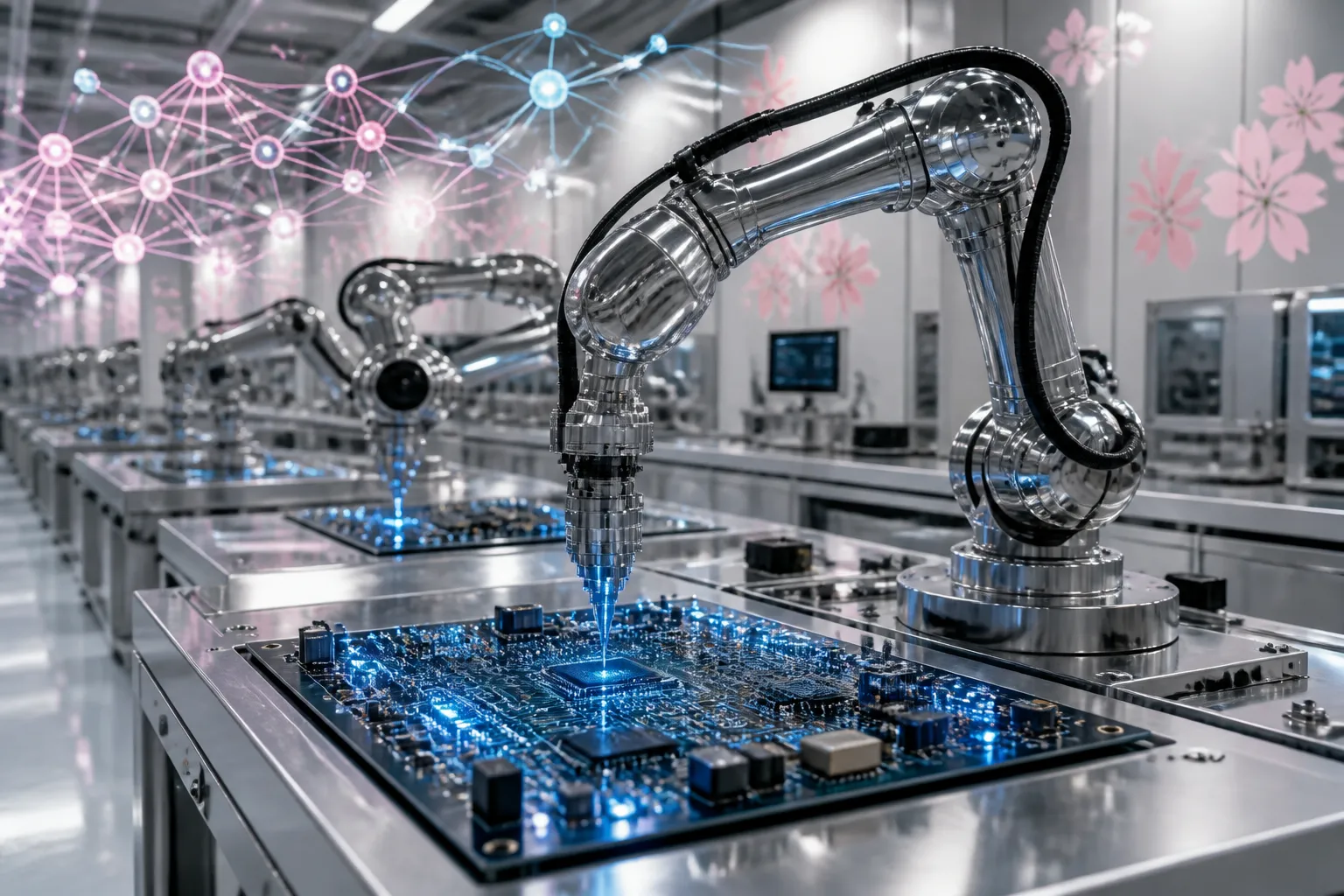
The collaboration aims to combine Nvidia’s AI training and inference capabilities with Fujitsu’s manufacturing expertise to create robots that can learn from digital twins and adapt to real‑world variations. The initiative is expected to accelerate the deployment of autonomous robots in settings where human labor is scarce, such as elder‑care facilities and production lines.
While the announcement did not disclose financial terms, the partnership follows a broader trend of Japanese firms seeking to catch up with global leaders in AI. Analysts note that Japan’s AI market has lagged behind China and the United States, and the government’s investment plan reflects a desire to reverse that trend.
As of now, the project remains in the planning stage. No joint venture has been announced, and the companies have not provided a timetable for when the robots will reach commercial production. The first phase of the collaboration is expected to commence later in 2026, with further details likely to emerge as the partnership develops.
The initiative represents a significant step toward integrating advanced AI into Japan’s manufacturing ecosystem, potentially offering a new tool to address demographic challenges and labor shortages. The outcome of the collaboration will be closely watched by industry observers and policymakers alike.
The partnership builds on a technology‑infrastructure deal signed between Fujitsu and Nvidia last year. According to the AP, the new initiative will fuse Nvidia’s GPU‑based AI platforms with Fujitsu’s manufacturing know‑how and digital‑twins technology. The goal is to create robots that can operate safely beside humans in factories, homes and hospitals, a capability that could help offset Japan’s acute labor shortage and aging population.
"Physical AI is a good fit for Japan because of the country’s reputation for manufacturing quality," Nvidia CEO Jensen Huang said at the event. He highlighted Japan’s culture of continuous improvement—kaizen—as a foundation for developing precise, reliable robots. Fujitsu CEO Takahito Tokita added that the collaboration would leverage the country’s strengths in robotics and AI to produce solutions that meet high safety and performance standards.
The companies did not set a specific launch date for the robots. They said the first phase of the collaboration would begin later in 2026, with no decision yet on a joint venture. The announcement follows the Japanese government’s plan, announced by Prime Minister Sanae Takaichi, to invest more than 370 trillion yen ($2.3 trillion) in technology fields including physical AI, semiconductors and data centers by 2040.
Nvidia’s open‑source AI tools have been used in a range of Japanese partnerships, including with banks, Toyota Motor Corp., Sega and the national research institute Riken. The company’s DGX platform, a fully integrated hardware‑software AI system, is designed to train and deploy physical‑AI models. Fujitsu, which provides enterprise computing products and services, has a long history of developing industrial automation systems; its predecessor, the Fuji Automatic Numerical Control (FANUC) group, remains the world’s largest maker of industrial robots.
Fanuc, Yaskawa and Kawasaki are among the largest manufacturers of industrial robots in Japan. Fanuc’s robots are widely used in manufacturing, while Yaskawa’s Motoman line serves welding, packaging and material handling. Kawasaki Heavy Industries also produces industrial robots for automotive and other sectors. Their participation signals a broad industry commitment to the project.
The collaboration aims to combine Nvidia’s AI training and inference capabilities with Fujitsu’s manufacturing expertise to create robots that can learn from digital twins and adapt to real‑world variations. The initiative is expected to accelerate the deployment of autonomous robots in settings where human labor is scarce, such as elder‑care facilities and production lines.
While the announcement did not disclose financial terms, the partnership follows a broader trend of Japanese firms seeking to catch up with global leaders in AI. Analysts note that Japan’s AI market has lagged behind China and the United States, and the government’s investment plan reflects a desire to reverse that trend.
As of now, the project remains in the planning stage. No joint venture has been announced, and the companies have not provided a timetable for when the robots will reach commercial production. The first phase of the collaboration is expected to commence later in 2026, with further details likely to emerge as the partnership develops.
The initiative represents a significant step toward integrating advanced AI into Japan’s manufacturing ecosystem, potentially offering a new tool to address demographic challenges and labor shortages. The outcome of the collaboration will be closely watched by industry observers and policymakers alike.








