Blab Tech
Drone Light Shows Illuminate Americas 250th Independence Day, Offering Fireworks Alternative
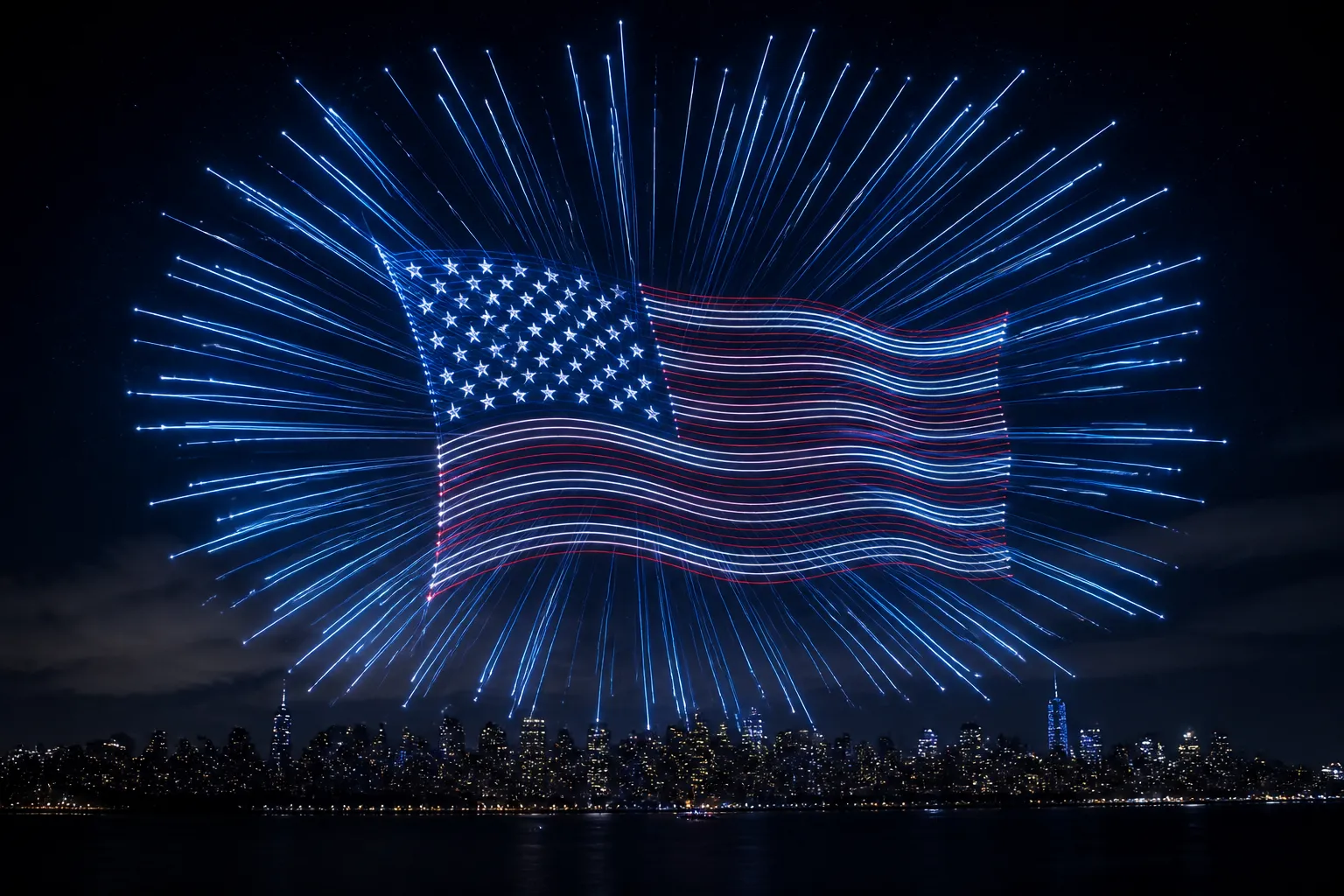
The United States is celebrating its 250th anniversary of independence with a mix of fireworks and drone light shows. In 2026, cities from La Jolla, California, to Arlington Heights, Illinois, and North Tarrant County, Texas, have scheduled synchronized drone displays to replace or complement traditional pyrotechnics. The shift is driven by safety concerns, noise issues, and the ability to create interactive visuals such as scannable QR codes.
Drone light shows use small unmanned aerial vehicles equipped with LED lights. Each drone acts as a pixel in a three‑dimensional grid. According to reports, a show with 500 drones requires about 70 hours of programming and costs between $50,000 and $100,000. A smaller show of 100 drones can be staged for $15,000 to $30,000. The drones have GPS for centimeter‑level positioning, batteries that last 15 to 20 minutes, and operators who manage the fleet from a ground station. If a drone fails, the software redistributes the visual across the remaining aircraft in real time.
A notable example of drone technology was the SXSW event in Austin, Texas, where Sky Elements, the largest U.S. drone show company, formed a giant QR code in the sky. Thousands of spectators pointed their phones at the pattern and scanned it. The code linked to a music video for Rick Astley’s “Never Gonna Give You Up,” effectively rick‑rolling the entire city. Sky Elements has since performed similar QR code displays at other events, linking audiences to movie trailers, app downloads, concert tickets, and brand activations. The company claims that a minimum of 500 drones is required for a scannable QR code at altitude, because the pixel density must match the resolution of a smartphone camera.
The move away from fireworks is partly a response to wildfire risk. Fireworks have ignited thousands of fires in California since 2020. In Colorado, 15 active wildfires were burning on July 4, 2026, prompting cities such as Denver, Lakewood, Durango, Fruita, and Thornton to adopt drone shows. A drone crash could ignite a battery, and a fireworks misfire can start a wildfire. Drones also produce no debris or smoke, and they are virtually silent, which is important for veterans with PTSD, families with young children, and pets. Veterinarians report that calls for fireworks‑related anxiety spike every July 4. In contrast, a drone show hums quietly and leaves no risk of embers landing on roofs.
La Jolla, California, has hosted a drone show for four consecutive years. The 500‑drone display above La Jolla Cove began at 8:45 p.m. on July 4, 2026, and the city has not returned to fireworks. In Washington, D.C., organizers are attempting a world‑record fireworks display of 850,000 pyrotechnics from Pennsylvania‑based Pyrotechnico, covering seven themes over forty minutes. North Tarrant County, Texas, will feature a 2,500‑drone display alongside traditional fireworks to mark the 250th birthday. Santa Fe, New Mexico, will synchronize a drone show with music to its fireworks at Franklin E. Miles Park. Arlington Heights, Illinois, is hosting its first Fourth of July celebration in five years, with a drone‑only show titled “Taking America’s 250th Celebration to the Heights.”
Not all communities are convinced. Laguna Beach, California, tried drone shows in 2024, but crowds were underwhelmed. The city returned to fireworks in 2025 and again this year. Some veterans have noted that the hum of drone motors can trigger anxiety, similar to fireworks. The experience of a firework’s flash, the concussion, and the collective gasp of a crowd are difficult to replicate with silent LED lights, even when choreography is precise.
The drone‑driven Fourth of July is still evolving. While drones are not replacing fireworks everywhere, they are becoming part of the celebration toolkit. They offer a safer, quieter, and more customizable alternative that can include interactive elements like QR codes. The 2026 celebrations will test the limits of the technology, the public’s reception, and the regulatory framework that governs drone operations over people and in national airspace.
Drone light shows use small unmanned aerial vehicles equipped with LED lights. Each drone acts as a pixel in a three‑dimensional grid. According to reports, a show with 500 drones requires about 70 hours of programming and costs between $50,000 and $100,000. A smaller show of 100 drones can be staged for $15,000 to $30,000. The drones have GPS for centimeter‑level positioning, batteries that last 15 to 20 minutes, and operators who manage the fleet from a ground station. If a drone fails, the software redistributes the visual across the remaining aircraft in real time.
A notable example of drone technology was the SXSW event in Austin, Texas, where Sky Elements, the largest U.S. drone show company, formed a giant QR code in the sky. Thousands of spectators pointed their phones at the pattern and scanned it. The code linked to a music video for Rick Astley’s “Never Gonna Give You Up,” effectively rick‑rolling the entire city. Sky Elements has since performed similar QR code displays at other events, linking audiences to movie trailers, app downloads, concert tickets, and brand activations. The company claims that a minimum of 500 drones is required for a scannable QR code at altitude, because the pixel density must match the resolution of a smartphone camera.
The move away from fireworks is partly a response to wildfire risk. Fireworks have ignited thousands of fires in California since 2020. In Colorado, 15 active wildfires were burning on July 4, 2026, prompting cities such as Denver, Lakewood, Durango, Fruita, and Thornton to adopt drone shows. A drone crash could ignite a battery, and a fireworks misfire can start a wildfire. Drones also produce no debris or smoke, and they are virtually silent, which is important for veterans with PTSD, families with young children, and pets. Veterinarians report that calls for fireworks‑related anxiety spike every July 4. In contrast, a drone show hums quietly and leaves no risk of embers landing on roofs.
La Jolla, California, has hosted a drone show for four consecutive years. The 500‑drone display above La Jolla Cove began at 8:45 p.m. on July 4, 2026, and the city has not returned to fireworks. In Washington, D.C., organizers are attempting a world‑record fireworks display of 850,000 pyrotechnics from Pennsylvania‑based Pyrotechnico, covering seven themes over forty minutes. North Tarrant County, Texas, will feature a 2,500‑drone display alongside traditional fireworks to mark the 250th birthday. Santa Fe, New Mexico, will synchronize a drone show with music to its fireworks at Franklin E. Miles Park. Arlington Heights, Illinois, is hosting its first Fourth of July celebration in five years, with a drone‑only show titled “Taking America’s 250th Celebration to the Heights.”
Not all communities are convinced. Laguna Beach, California, tried drone shows in 2024, but crowds were underwhelmed. The city returned to fireworks in 2025 and again this year. Some veterans have noted that the hum of drone motors can trigger anxiety, similar to fireworks. The experience of a firework’s flash, the concussion, and the collective gasp of a crowd are difficult to replicate with silent LED lights, even when choreography is precise.
The drone‑driven Fourth of July is still evolving. While drones are not replacing fireworks everywhere, they are becoming part of the celebration toolkit. They offer a safer, quieter, and more customizable alternative that can include interactive elements like QR codes. The 2026 celebrations will test the limits of the technology, the public’s reception, and the regulatory framework that governs drone operations over people and in national airspace.








