Blab Tech
China to Open First Fully Robot-Run Hotel on Shenzhen-Zhongshan Link Island in 2027
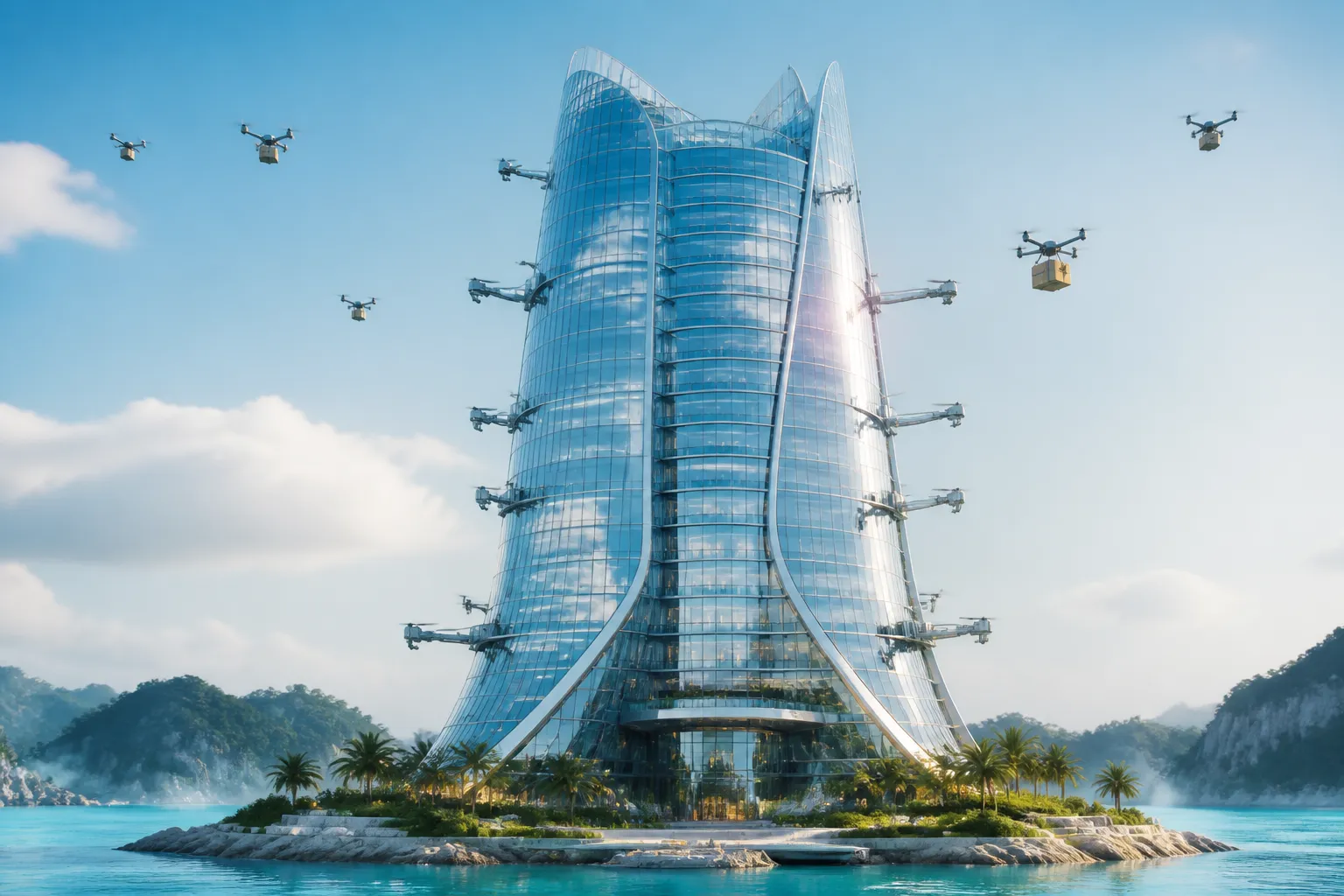
A Chinese robotics firm has unveiled plans to launch the world’s first hotel run entirely by autonomous machines. The project, spearheaded by Pudu Robotics, will open in 2027 on the West Artificial Island—an engineered landmass that sits within the Shenzhen–Zhongshan Link, the bridge‑and‑tunnel artery that stitches Shenzhen to Zhongshan in Guangdong Province.
The hotel will house 44 luxury rooms, a dining venue, a gym, and a suite of leisure amenities. Every guest interaction—from the moment a traveler checks in to the delivery of room service, housekeeping, and even food preparation—will be handled by a coordinated fleet of robots. Pudu’s marketing team calls the venture a “full‑scenario robot‑serviced hotel,” emphasizing that the robots will not merely assist staff but will own the entire operational workflow.
At the heart of the system is Pudu’s proprietary artificial‑intelligence ecosystem, built around the PuduFM 1.0 model and the PuduAgent software. These components act as a nervous system, orchestrating communication and service choreography among the various robotic actors.
The hotel’s workforce will be a mix of specialized machines. FlashBot will act as a mobile concierge, delivering items and enabling guests to order goods via their smartphones. PUDU T300 will haul luggage from the lobby to rooms. Cleaning will be handled by PUDU CC1 Pro and PUDU MT1, both of which employ AI to detect waste and adapt their sweeping patterns to the environment. Reception robots will be equipped to read gestures and engage socially, while delivery bots will chart optimal routes on their own.
A limited‑scope trial is slated to begin in late 2026. During this phase, only a handful of rooms and services will be active, allowing early visitors to experience a purely robotic check‑in and in‑room delivery system.
The initiative fits into a broader strategy to transform the West Artificial Island into a technology‑centric destination. Pudu Robotics has teamed with Shenzhen Culture & Tourism Industry Development to showcase AI and robotics as core elements of the visitor experience. Cong Guo, co‑founder and chief technology officer of Pudu, said, “Our robots will participate in every aspect of the hotel’s operations, delivering seamless service without interruptions and without human intervention.”
The Shenzhen–Zhongshan Link itself opened in June 2024, featuring a network of bridges and tunnels that cross the Pearl River Delta. The artificial island was constructed during the link’s build, positioning the hotel at the center of a nascent tech hub expected to draw tourists and investors alike.
Industry observers note that the hotel marks a significant milestone for hospitality automation. While some establishments have experimented with robot‑assisted services, this project is the first to claim full operational control by autonomous systems. The outcome could influence future hotel designs, particularly in regions where labor shortages or cost pressures push operators toward automation.
The timeline remains on track: a trial in late 2026 followed by a full opening in 2027, at which point all 44 rooms and the full suite of amenities will be available. No additional funding or regulatory approvals have been reported, and the company has not disclosed any financial details.
As the hotel approaches its debut, the hospitality sector will watch closely to gauge how the robot‑run model performs and whether it can be replicated elsewhere. The venture also raises questions about workforce displacement, guest privacy, and the regulatory framework governing autonomous service robots in public spaces.
In short, Pudu Robotics is poised to inaugurate the world’s first fully robot‑run hotel on the West Artificial Island of the Shenzhen–Zhongshan Link in 2027, following a trial period in late 2026. The property will offer 44 luxury rooms and a range of amenities, all serviced by a fleet of AI‑controlled robots coordinated through the PuduFM 1.0 and PuduAgent systems. The project is part of a larger push to establish the island as a technology hub and may signal a new direction for the hospitality industry.
The hotel will house 44 luxury rooms, a dining venue, a gym, and a suite of leisure amenities. Every guest interaction—from the moment a traveler checks in to the delivery of room service, housekeeping, and even food preparation—will be handled by a coordinated fleet of robots. Pudu’s marketing team calls the venture a “full‑scenario robot‑serviced hotel,” emphasizing that the robots will not merely assist staff but will own the entire operational workflow.
At the heart of the system is Pudu’s proprietary artificial‑intelligence ecosystem, built around the PuduFM 1.0 model and the PuduAgent software. These components act as a nervous system, orchestrating communication and service choreography among the various robotic actors.
The hotel’s workforce will be a mix of specialized machines. FlashBot will act as a mobile concierge, delivering items and enabling guests to order goods via their smartphones. PUDU T300 will haul luggage from the lobby to rooms. Cleaning will be handled by PUDU CC1 Pro and PUDU MT1, both of which employ AI to detect waste and adapt their sweeping patterns to the environment. Reception robots will be equipped to read gestures and engage socially, while delivery bots will chart optimal routes on their own.
A limited‑scope trial is slated to begin in late 2026. During this phase, only a handful of rooms and services will be active, allowing early visitors to experience a purely robotic check‑in and in‑room delivery system.
The initiative fits into a broader strategy to transform the West Artificial Island into a technology‑centric destination. Pudu Robotics has teamed with Shenzhen Culture & Tourism Industry Development to showcase AI and robotics as core elements of the visitor experience. Cong Guo, co‑founder and chief technology officer of Pudu, said, “Our robots will participate in every aspect of the hotel’s operations, delivering seamless service without interruptions and without human intervention.”
The Shenzhen–Zhongshan Link itself opened in June 2024, featuring a network of bridges and tunnels that cross the Pearl River Delta. The artificial island was constructed during the link’s build, positioning the hotel at the center of a nascent tech hub expected to draw tourists and investors alike.
Industry observers note that the hotel marks a significant milestone for hospitality automation. While some establishments have experimented with robot‑assisted services, this project is the first to claim full operational control by autonomous systems. The outcome could influence future hotel designs, particularly in regions where labor shortages or cost pressures push operators toward automation.
The timeline remains on track: a trial in late 2026 followed by a full opening in 2027, at which point all 44 rooms and the full suite of amenities will be available. No additional funding or regulatory approvals have been reported, and the company has not disclosed any financial details.
As the hotel approaches its debut, the hospitality sector will watch closely to gauge how the robot‑run model performs and whether it can be replicated elsewhere. The venture also raises questions about workforce displacement, guest privacy, and the regulatory framework governing autonomous service robots in public spaces.
In short, Pudu Robotics is poised to inaugurate the world’s first fully robot‑run hotel on the West Artificial Island of the Shenzhen–Zhongshan Link in 2027, following a trial period in late 2026. The property will offer 44 luxury rooms and a range of amenities, all serviced by a fleet of AI‑controlled robots coordinated through the PuduFM 1.0 and PuduAgent systems. The project is part of a larger push to establish the island as a technology hub and may signal a new direction for the hospitality industry.








