Blab Tech
Japans Tiny SORA-Q Rover Completes 100-Minute Autonomous Mission on the Moon
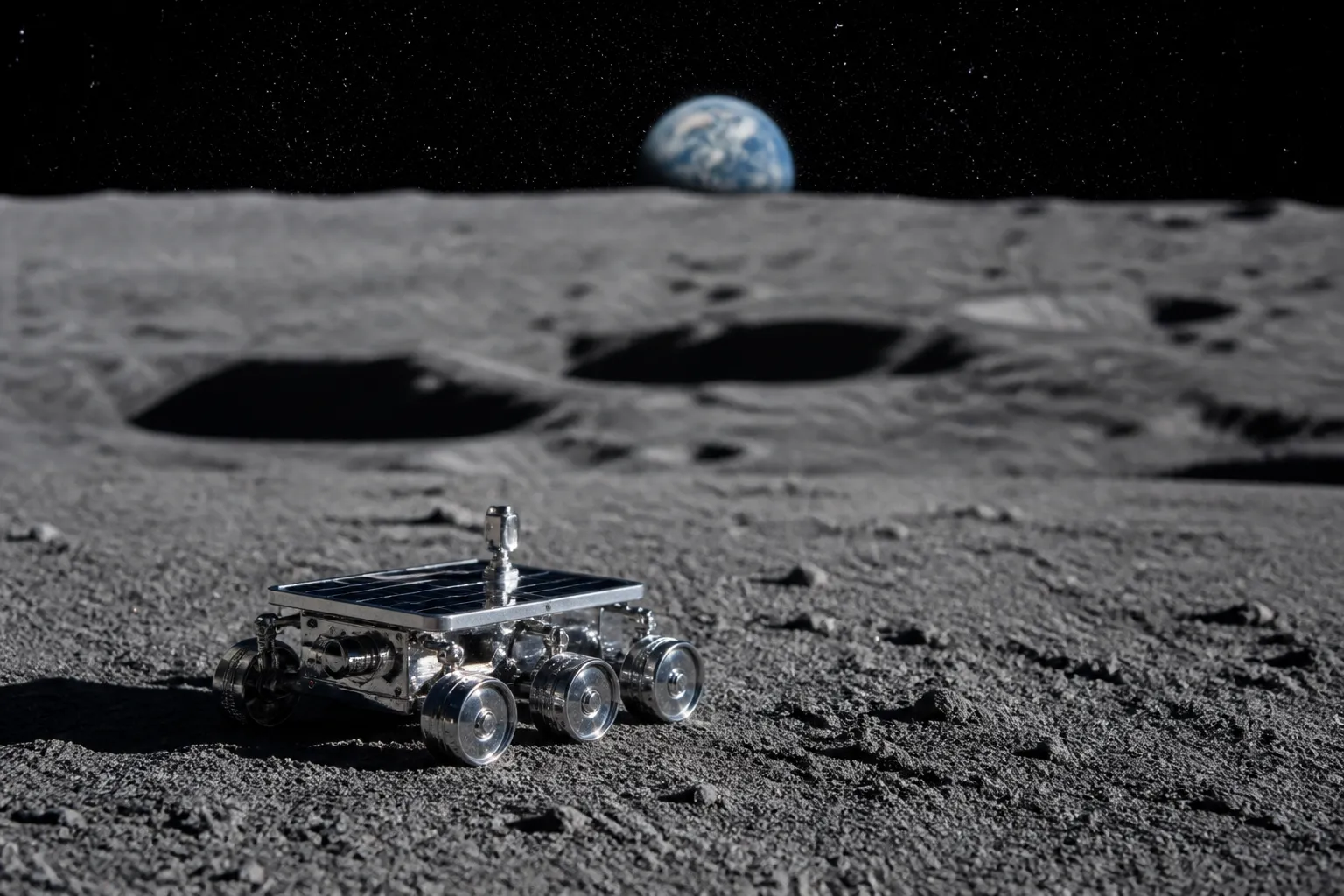
A palm‑sized rover, no larger than a golf ball, spent 100 minutes exploring the Moon’s surface, covering roughly 24 meters and sending back a handful of high‑resolution images. The robot, called LEV‑2 and nicknamed SORA‑Q, was deployed from JAXA’s SLIM lander near Shioli crater on 19 January 2024.
LEV‑2 is a three‑inch‑wide sphere that morphs after touchdown. The outer shell splits into two hemispheres that become wheels around a central shaft, while a front‑facing camera and a stabilization tail sit inside the core. Weighing about eight ounces (≈225 g), the rover was built with Sony Group Corporation, toy maker TOMY and Doshisha University. Its toy‑inspired transformer design has been tweaked to survive lunar dust, extreme temperatures and vacuum.
The rover ran entirely on its own. Onboard sensors and pre‑loaded navigation algorithms guided it past obstacles and kept it moving in a straight line. A Sony Spresense micro‑controller and custom software processed data from an inertial measurement unit and the front camera. The camera captured 12 high‑resolution shots of the lunar surface and of the SLIM lander itself, which were relayed back to Earth via the lander’s communication system.
LEV‑2 was one of two small rovers carried by SLIM; the other, LEV‑1, is a hopping robot that communicates directly with Earth. SLIM, launched on 6 September 2023 aboard an H‑IIA rocket, entered lunar orbit on 25 December 2023 and softly landed near Shioli crater on 19 January 2024. The lander’s primary goal was to prove precision landing, hitting within a 100‑meter radius of a pre‑selected target. After a brief battery‑powered phase, SLIM powered down on 20 January but was revived nine days later when its solar panels received enough sunlight.
The demonstration matters because it shows that a single, lightweight rover can conduct autonomous surface exploration without the support of a large, complex lander. Its small size and low mass reduce launch costs and allow multiple units to be deployed in a single mission. Analysts note that fleets of inexpensive robots could increase survey coverage and provide redundancy in harsh environments where individual units may be lost.
JAXA’s technical report, highlighted by Singularity Hub, stresses that while a single small rover’s capabilities are limited, the results underscore the potential of such platforms as independent explorers. The report calls for future studies on durability metrics—dust mitigation, thermal cycling, wheel wear—and on communication protocols for multi‑agent coordination.
SLIM’s mission ended on 23 August 2024, setting a world record for longevity among lunar surface spacecraft that do not use a radioisotope thermoelectric generator. The lander and its rovers operated for four lunar days before going silent in late May. JAXA has announced plans for a follow‑up mission, Resilience, scheduled to launch in the fourth quarter of 2024 on a SpaceX Falcon 9. Resilience will carry a micro‑rover similar to LEV‑2, aiming to further test autonomous exploration capabilities.
Today, the LEV‑2 data set is being analyzed by JAXA, Sony and TOMY to assess the rover’s performance under lunar conditions. The mission’s success provides a proof‑of‑concept for future swarm‑based exploration, but questions remain about long‑term durability, dust protection and the scalability of autonomous coordination among multiple units. The next steps will involve detailed engineering studies and the design of larger fleets that can operate cooperatively on the Moon’s surface.
LEV‑2 is a three‑inch‑wide sphere that morphs after touchdown. The outer shell splits into two hemispheres that become wheels around a central shaft, while a front‑facing camera and a stabilization tail sit inside the core. Weighing about eight ounces (≈225 g), the rover was built with Sony Group Corporation, toy maker TOMY and Doshisha University. Its toy‑inspired transformer design has been tweaked to survive lunar dust, extreme temperatures and vacuum.
The rover ran entirely on its own. Onboard sensors and pre‑loaded navigation algorithms guided it past obstacles and kept it moving in a straight line. A Sony Spresense micro‑controller and custom software processed data from an inertial measurement unit and the front camera. The camera captured 12 high‑resolution shots of the lunar surface and of the SLIM lander itself, which were relayed back to Earth via the lander’s communication system.
LEV‑2 was one of two small rovers carried by SLIM; the other, LEV‑1, is a hopping robot that communicates directly with Earth. SLIM, launched on 6 September 2023 aboard an H‑IIA rocket, entered lunar orbit on 25 December 2023 and softly landed near Shioli crater on 19 January 2024. The lander’s primary goal was to prove precision landing, hitting within a 100‑meter radius of a pre‑selected target. After a brief battery‑powered phase, SLIM powered down on 20 January but was revived nine days later when its solar panels received enough sunlight.
The demonstration matters because it shows that a single, lightweight rover can conduct autonomous surface exploration without the support of a large, complex lander. Its small size and low mass reduce launch costs and allow multiple units to be deployed in a single mission. Analysts note that fleets of inexpensive robots could increase survey coverage and provide redundancy in harsh environments where individual units may be lost.
JAXA’s technical report, highlighted by Singularity Hub, stresses that while a single small rover’s capabilities are limited, the results underscore the potential of such platforms as independent explorers. The report calls for future studies on durability metrics—dust mitigation, thermal cycling, wheel wear—and on communication protocols for multi‑agent coordination.
SLIM’s mission ended on 23 August 2024, setting a world record for longevity among lunar surface spacecraft that do not use a radioisotope thermoelectric generator. The lander and its rovers operated for four lunar days before going silent in late May. JAXA has announced plans for a follow‑up mission, Resilience, scheduled to launch in the fourth quarter of 2024 on a SpaceX Falcon 9. Resilience will carry a micro‑rover similar to LEV‑2, aiming to further test autonomous exploration capabilities.
Today, the LEV‑2 data set is being analyzed by JAXA, Sony and TOMY to assess the rover’s performance under lunar conditions. The mission’s success provides a proof‑of‑concept for future swarm‑based exploration, but questions remain about long‑term durability, dust protection and the scalability of autonomous coordination among multiple units. The next steps will involve detailed engineering studies and the design of larger fleets that can operate cooperatively on the Moon’s surface.